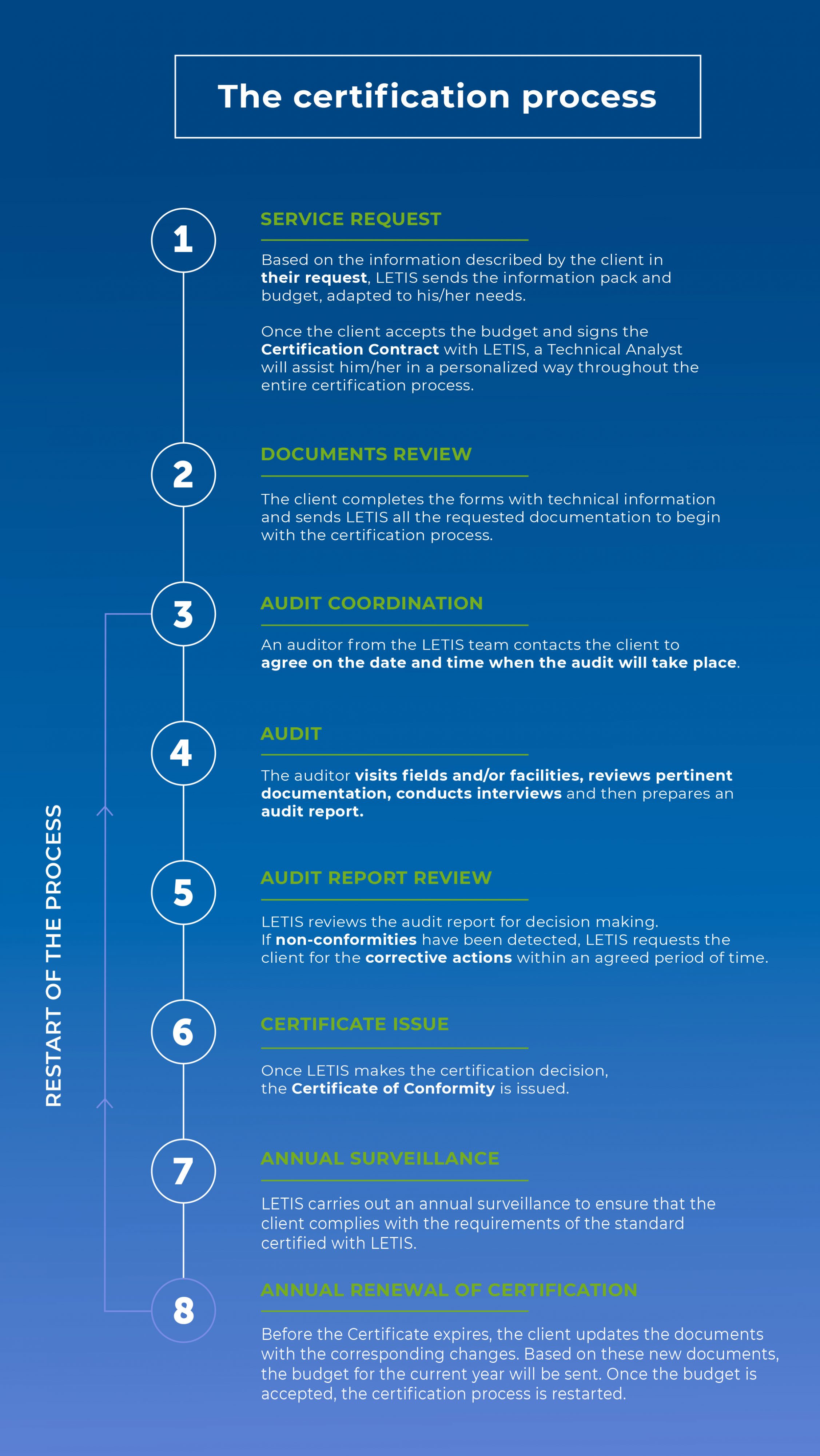











Certification is a formal process by which LETIS, acting as an independent third-party certification body accredited in accordance with ISO/IEC 17065, provides assurance that an operator complies with a specific regulation, standard, or quality protocol.
Compliance is assessed through a systematic and methodical audit process conducted by LETIS, which is accredited by national and international accreditation and oversight bodies.
All information related to certification and the Schedule of Fees are publicly available.
Please request them by sending an email to: [email protected]
LETIS has provided services to the agricultural activity since 1998, certifying organic productions, quality protocols and good agricultural practices in grains, fibers, fruits and vegetables, seeds and propagation material.
The certification is a business tool to access new markets, set up in business in existing markets, increase the sale of certain products and add value to them.
Compliance with quality protocols such as Good Agriculture Practices (GAP), GLOBALG.A.P. and Organic has become a requirement to enter the main markets of the world. The Organic certification ensures the traceability and differentiation of your products.
Honey is a product that is increasingly in demand worldwide. The Certification is a business tool to access new markets, set up in business in existing markets, increase the sale of certain products and add value to them.
When the honey is obtained from a sustainable production system over time, through the rational management of natural resources and without the use of chemical synthesis products, these characteristics can be clearly identified by consumers through a system of organic production certification.
LETIS is a leading company in the certification of apiculture productions, with a team that has more than 15 years of experience in the activity
LETIS has provided services to the livestock sector since 1998, certifying bovine, goat, sheep, pig and other farm animal productions, slaughterhouses, meat processing plants and other processing plants.
The Certification is a business tool to access new markets, set up in business in existing markets, increase the sale of certain products and add value to them.
Good practices in livestock production are developed with a harmonious relationship between land, plants and livestock. It respects the physiological and behavioral needs of animals, through a combination of measures aimed at providing good quality food produced organically, while maintaining livestock densities appropriate to behavioral needs. Adopting livestock management practices minimizes the stress and seeks to promote animal welfare. This production acquires a differential value that can be highlighted through a certification system.
Aquaculture is one of the fastest growing food activities in the world, and quality certifications are key to entering the most demanding markets.
LETIS has been the first certification body to certify an organic aquaculture production in Argentina, in an enterprise of rainbow trout in Patagonia. Today it certifies fish and bivalve mollusk productions in various Latin American countries.
LETIS has provided services to the wild collection sector since 1998, certifying the collection of plants, algae, fruits, fungi, among others, and their processing. Wild harvesting techniques consciously avoid exploiting wild plant communities, and are carried out with utmost care and respect for nature.
The Certification is a business tool to access new markets, set up in business in existing markets, increase the sale of certain products and add value to them.
LETIS is a leader in the certification of vineyards and wineries. LETIS has been working with a highly experienced team in the wine industry since 1998.
The Certification is a business tool to access new markets, set up in business in existing markets, increase the sale of certain products and add value to them.
The added value in the production of food and beverages is certified by LETIS in its different stages, from the collection and conditioning of cereals, to the production of fruit juices, baked goods, and the elaboration of gourmet products, among others.
Organic Cosmetics: The objective of the organic certification is to verify that the raw materials that are being used in the processing of cosmetics have been produced following the criteria for organic agriculture. These criteria include the non-use of chemical fertilizers, pesticides or herbicides of chemical synthesis, maintaining a healthy production, ensuring sustainability with the environment. With the organic certification, you assure the consumer that the chemicals and pollutants, which affect the environment and the skin, are highly reduced in your products.
A NOP (USDA) certified, cosmetics, personal care products, and body care products are eligible for the same 4 organic labeling categories as all other agricultural products, based on their organic content and other factors:
GMP in Cosmetics production: Good Manufacturing Practices are a basic tool for obtaining safe products for human consumption, which focus on hygiene and handling.
The LETIS BPM program grants this certification according to the IRAM 324 standard.
This standard is applicable to establishments / factories / laboratories in which some of the following activities are carried out: elaboration, industrialization, fractionation, storage, transportation and distribution.
For an imported product to be sold as organic, for most of the organic norms the trader shall be certified as such.
All organic products imported into the EU must have the appropriate electronic certificate of inspection (e-COI). These are issued and administered by LETIS through the Expert System (TRACES). Please note that if you do not have an electronic certificate of inspection, your products will not be released from their port of arrival in the EU.
The trading of certified organic goods by LETIS for the norms SENASA Argentina and SENASA Peru for domestic or international purposes, also requires the issuance of Transactional Certificates for each transaction. The same shall be requested to LETIS by a certified operator.
In the case of NOP (USA), under the current USDA organic regulations, traders that do not physically handle organic products are not required to be certified. However they may be certified voluntarily. In fact, many traders choose to be certified, for instance, in order to be shown in the USDA oficial integrity database. Please note that the proposed changes to the USDA organic regulations eliminate the exclusions from certification and would require all traders to be certified. The new rules should be in place in 2022.
For more information about the requirements of each market, please contact us! at [email protected]
LETIS provides the service of evaluation and approval of commercial inputs to be used in organic production. The inputs that obtain approval may use a distinctive seal, which gives them greater added value, thus allowing them to differentiate themselves in the market. Furthermore, LETIS publishes on its website the “List of Approved Inputs for Use in Organic Agriculture” where companies demanding organic supplies, people and related institutions will be able to know the trademarks, manufacturers and registrants of the authorized inputs.
By “organic”, “ecological” or “biological” is understood to be any plant / animal / aquaculture product from a sustainable production system that, through the rational management of natural resources and without the use of chemical synthesis products. The organic system provides healthy and abundant food, while allowing the maintenance or increase of the fertility of the resource, its biotic activity and biological diversity. These products must allow consumers to clearly identify their organic status through a certification system that guarantees it.
Countries that have their own organic legislation on production and organic control system require by law that products labeled as “organic”, “ecological” or “biological” be certified according to their national standard, through accredited third-party certifiers as LETIS.
In addition to being a source of healthy and environmentally friendly food, organic products are a growing consumer trend and attractive to the producer due to their premium prices. The certification allows the producer to access different international markets.
LETIS offers auditing and certification services for the organic standards of the following countries:
LETIS has a nationally applicable organic certification program (Law 25,127 and its regulations), equivalent to the organic regulations of the European Union.
The LETIS SUE program allows organic products manufactured in Argentina to also be marketed within the countries of the European Union. Certification is carried out throughout the production chain: primary production, processing and trading.
LETIS certifies an enormous diversity of agricultural-livestock productions and their associated agro-industry, guaranteeing the quality and experience in the service provided.
This regulation aims to ensure a possible productive management system that:
The SENASA – European Union equivalence does not include the scope of aquaculture and viticulture. For these scopes, we offer the LETIS SENASA (Argentina) and LETIS EEQ (European Union) programs.
Those producers located outside of Argentina and who wish to market their products in the country, must certify the LETIS SENASA Argentina standard.
Since 2002, organic products wishing to enter the United States must comply with the NOP (National Organic Program). This program is regulated by the USDA (United States Department of Agriculture). LETIS is directly accredited by the USDA to audit and certify these regulations worldwide.
Through the LETIS NOP-USCOEA program, we offer the possibility of certifying the equivalence between the organic standards of the United States and Canada, in order to access both the US and Canadian markets.
LETIS Peru is accredited by SENASA Peru to carry out audits and certification of the organic standard, in accordance with the Reglamento Técnico para los Productos Orgánicos (2006) and Supreme Decree DS 010-2010-AG.
LETIS performs the audits for the Brazilian organic standard, in compliance with Law No. 10.831 and works together with a fellow certifier, which issues the certification.
LETIS is accredited by the Canadian Food Inspection Agency to certify organic products in compliance with the requirements of the COR (Canadian Organic Regime) standard. LETIS offers this certification worldwide.
Through the LETIS COR-USCOEA program, we offer the possibility of certifying the equivalence between the Canada and US organic standards, in order to access both the Canadian and US markets.
LETIS is accredited by CAEQ (Comittee on Accreditation for Evaluation of Quality) to certify the CARTv standard (Quebec). This is the organic standard for the Quebec canadian region.
This standard is mandatory for:
LETIS performs the audits in compliance with the Organic Products Law (LPO) of Mexico DOF 07-02-2006 and works in conjunction with a peer certifier, which issues the certification.
LETIS has qualified and approved auditors to carry out product certification audits under the South Korean Organic Standard. This is made possible through an agreement between LETIS and the South Korean certification body WECERT, which issues the certificates of conformity for this standard based on LETIS audits.
China Organic Product Certification Services under China National Organic Product Standard (GB/T 19630-2011).
The GB/T19630-2011 Standard for Organic Products is applicable for all organic products for sale in the Chinese market, including domestic and imported products. The products can be sold legally as organic products in Chinese market only with certification of such standard. The standard consists of four parts, which respectively specify the requirements in the field of organic production, processing, marking, selling and management system.
LETIS has a cooperation agreement with SRS Shanghai, who is the certifier entity accredited for the GBT Standard.
Letis Bioteam is authorized as an Organic Agriculture Control and Certification Body by the Ministry of Agriculture and Forestry of Turkey.
Furthermore, is accredited by the Turkish Accreditation Agency, according to the provisions of the Organic Agriculture Law No. 5262 and the Turkish Regulation on the Principles and Practice of Organic Agriculture.
Contenido del acordeón
El Certificado GLOBALG.A.P. abarca las Buenas Prácticas Agrícolas a nivel global. Contempla principalmente los siguientes puntos: trazabilidad (seguimiento), técnicas de producción (uso controlado de agroquímicos), protección del medio ambiente, aspectos higiénicos (no contaminación química, física y biológica) y sociales (ambiente de trabajo adecuado). Está conformada por módulos integrando el proceso de producción, desde su comienzo hasta que el producto es retirado del establecimiento.
GLOBALG.A.P. es una certificación “business to business (B2B)”, lo que significa que conecta, a través de un certificado de conformidad, a su empresa con otras tales como comercializadoras, distribuidoras y supermercados internacionales y nacionales, que buscan proveedores de alta calidad comprobada.
LETIS está acreditada para certificar el alcance GLOBALG.A.P. IFA (Norma para el Aseguramiento Integrado de Fincas) en frutas, hortalizas y cultivos a granel.
¿Cómo certificar?
La Norma GLOBALG.A.P. se estructura en un sistema de módulos que permite a los productores certificarse para varios sub-ámbitos en una sola auditoría. Está compuesta por:
Los Puntos de Control y Criterios de Cumplimiento (PCCC) también se estructuran en módulos, y están conformados por:
Para obtener la certificación, los productores deben cumplir con todos los PCCC relevantes de su sub-ámbito. Por ejemplo, un productor de fresas debe cumplir con los PCCC del Módulo Base para Todo Tipo de Explotación Agropecuaria, los PCCC del Módulo Base para Cultivos, y los PCCC de Frutas y Hortalizas para recibir el Certificado de la Norma GLOBALG.A.P. IFA para Frutas y Hortalizas.
Opciones de certificación:
GLOBALG.A.P. + Add on
Como respuesta a las crecientes inquietudes que han surgido en torno a determinados temas del proceso de producción agropecuaria y de la cadena de suministro, GLOBALG.A.P. desarrolló los módulos “add-on”. Estos módulos, voluntarios y adicionales, buscan optimizar su certificación GLOBALG.A.P.
LETIS ofrece los siguientes Add on:
FSMA PSR – Ley de Modernización de Inocuidad de los Alimentos (Food Safety Modernization Act – FSMA), de la Administración de Alimentos de los Estados Unidos (FDA).
La FDA promulgó esta ley en 2011 que abarca los productos para exportación a EEUU y también su producción interna, y exige que se implementen y sigan prácticas específicas para la producción, manipulación e importación de productos alimenticios.
Con el fin de apoyar a los productores en la implementación de estas prácticas, GLOBALG.A.P. ofrece su add-on FSMA PSR para tratar los puntos de control que se encuentran en la Regla sobre Seguridad de Productos de la FSMA (FSMA PSR).
Este Add-On ayuda a los productores a identificar los requisitos de la FSMA que deben abordarse a nivel de la granja, cuando va acompañado por la certificación IFA FV.
Se pueden mostrar los informes de inspección y los certificados de IFA FV y del add-on FSMA PSR a los importadores, los minoristas y los participantes de la cadena de valor como prueba del trabajo realizado por el productor para la implementación de la FSMA.
GRASP – Evaluación de Riesgos GLOBALG.A.P. para las Prácticas Sociales GLOBALG.A.P. Risk Assessment on Social Practice)
Es un módulo voluntario desarrollado para evaluar las prácticas sociales en la explotación, abordando temas específicos relativos a la salud, seguridad y bienestar de los trabajadores.
Como complemento de la Certificación GLOBALG.A.P., ayuda a los productores a establecer un buen sistema de gestión social en sus explotaciones, ofreciendo a los compradores una garantía adicional y protegiendo uno de los recursos más importantes de la explotación: sus trabajadores.
Las medidas GRASP pueden evaluarse al mismo tiempo que se realiza la auditoría GLOBALG.A.P. Un auditor o inspector GLOBALG.A.P. con formación en GRASP realiza la evaluación GRASP en su explotación. Los resultados de la evaluación se cargan en la Base de Datos GLOBALG.A.P., mostrando su nivel de cumplimiento. Esto es visible para los socios en la cadena de suministro y los compradores a los que se les haya otorgado acceso.
SPRING – Programa sostenible de riego y uso de aguas subterráneas
SPRING es un add-on a nivel de la granja que ayuda a los productores, a los minoristas y a los comerciantes a demostrar su compromiso con la gestión sostenible del agua, y puede aplicarse junto con la norma GLOBALG.A.P. IFA para Cultivos. SPRING incorpora un gran número de criterios para evaluar si en la granja se realiza una gestión sostenible del agua. Algunos de estos criterios son los siguientes:
Aquellos productores que aplican de manera eficaz el add-on SPRING reciben un certificado de conformidad, que también se puede ver en la base de datos GLOBALG.A.P. Los actores autorizados de las cadenas de suministro también pueden acceder al informe de auditoría completo como un «observador SPRING», a través de la base de datos GLOBALG.A.P.
Lorem ipsum dolor sit amet, consectetur adipiscing elit. Ut elit tellus, luctus nec ullamcorper mattis, pulvinar dapibus leo.
The BRCGS Global Standard for Food Safety is one of the most widely used tools globally for due diligence and supplier approval. Originally developed in 1998 by the British Retail Consortium, this standard is regularly updated with the collaboration of international stakeholders in the supply chain. Today, it is a global tool based on the latest and most advanced standards and methodologies in food safety, and it is recognized by the Global Food Safety Initiative (GFSI). What benefits does BRCGS certification offer to the sites that obtain it? The BRCGS Standard influences product sales worth US$ 800 billion, playing a crucial role in ensuring the supply of safe food. Therefore, international organizations promote its adoption to strengthen food safety systems and meet regulations. The certification applies to products manufactured or prepared at the audited facilities and includes storage facilities under the direct management control of the production site. This standard does not apply to activities related to wholesale, import, distribution, or storage of food products that are outside the direct control of the company.
The standard helps companies select and evaluate their suppliers by providing a framework for managing the safety, integrity, legality, and quality of products in the manufacturing industry, as well as in the processing and packaging of food and food ingredients.
Through BRCGS auditing and certification, companies can demonstrate their commitment to food safety, ensuring that their products meet the most stringent regulations and the expectations of the most demanding consumers.
The implementation and certification of this Standard offer several benefits to food companies and their customers, including:
LETIS is accredited only for food processing in all product categories according to BRCGS for Food Safety, Issue 9.
This standard outlines the requirements for the manufacturing, processing, and packaging of:
The LETIS GAP Program guarantees the reliable verification of compliance with Good Agricultural Practices, whose implementation is mandatory in Argentina since 2020 for fruitculture and in 2021 onwards for vegetables, according to the resolution of the Argentine National Government 5/2018.
The LETIS GAP program enables the entire process to be effectively managed with the IRAM 14110 standard, incorporating a sustainable vision into primary food production and making efficient use of resources and appropriate integrated management of pests and diseases.
The purpose of this standard is to establish the general criteria that allows to obtain safe products for consumption. Its field of application includes production, harvesting, storage, packaging and transportation.
Good Manufacturing Practices are a basic tool for obtaining safe products for human consumption, which focus on hygiene and handling.
The LETIS GMP program grants this certification according to the IRAM 324 standard.
This standard is applicable to establishments in which some of the following activities are carried out: preparation, industrialization, fractionation, storage, transportation and distribution of food and supplies in contact with them.
Compliance with the GMP is mandatory for all food processing establishments located in Argentina, and is a prerequisite for the HACCP Certification, TQM Program or any other Quality Management system such as ISO 9000 in agri-food companies.
Our team has developed the LETIS Vegan quality seal. This is our answer to the demands of the consumers and a result of our constant search for providing tools that facilitate transparency and communication of the essence, purpose and ways of working behind each product.
This “Business to Consumer” seal is easy to identify on certified products and is backed by a precise and responsible quality protocol and an accurate and responsible auditing and certification system.
The LETIS Vegan certification provides transparency to consumers who choose products that do not contain ingredients or sub-ingredients of animal origin, that have not been tested on animals, and that have been produced and traced avoiding cross contamination with products that do not comply with these characteristics.
Some of the requirements of this seal are covered by organic certification, HACCP and GMP, that is why we have developed a combined certification model, in which our clients can opt for these certifications under the same audit system.
Our team has developed the LETIS Free Hens seal, which seeks to meet consumer demands, providing tools to facilitate transparency and communication of the essence, purpose and ways of working behind each product.
This “Business to Consumer” seal is easy to identify on certified products and is backed by a
precise and responsible quality protocol and an accurate and responsible auditing and certification system.
LETIS Free Hens certification facilitates the choice of eggs from hens raised with practices that attend to animal welfare, such as the management of accommodation, food, health and veterinary treatment, seeking to reproduce their natural conditions and therefore both reducing their stress and ensuring a better quality of life for the animals.
Some of the requirements of this seal are covered by organic certification, that is why we have developed a combined certification model, in which our clients can opt for both certifications under the same audit system.
The HACCP system is used worldwide and it is also internationally recognized and requested.
It helps organizations to focus on biological, chemical and physical hazards that affect food safety and hygiene, by establishing Critical Control Points (CCPs) in the production process. It is basically a preventive system, with the objective of reducing the dangers of contamination and delivering safe products to customers and consumers.
The implementation of GMP should be considered as a prerequisite for HACCP certification.
The LETIS HACCP program grants this certification according to the IRAM 323 standard for Mercosur countries, or according to the Codex Alimentarius for other countries.
Some of the advantages of having this certification are:
The Seal “Argentine Food, a natural choice” is a country brand that seeks to differentiate foods produced in Argentina under a premium quality standard. It is granted by the Argentinian Secretary’s Office of Agriculture, Livestock and Fisheries to the products that request it and comply with the requirements established in specific protocols.
LETIS performs the third party audits of this program.
Products that have this Seal can obtain an additional 0.5% to the tariff position in Export Refunds (PEN Decree No. 1341/16).
The Tierra del Fuego-End of the World Certified Quality seal is a territorial brand developed by the Province of Tierra del Fuego, Argentina. It seeks to differentiate products produced in this Province, whose quality, sustainability and social responsibility meet the established requirements.
This seal covers quality, environmental and social responsibility protocols for various productions of the Province, such as sheep production for meat, aquaculture, gourmet products and furniture.
LETIS inspects, verifies compliance and grants the Tierra del Fuego-End of the World certified quality seal.
Honey free of Genetically modified Organisms (GMO free)
Este Protocolo para el Desarrollo Sostenible de la Vitivinicultura Argentina de Bodegas de Argentina, junto con su Reglamento, integra el Programa de Sustentabilidad para la Industria Vitivinícola Argentina. Se trata de una iniciativa colaborativa desarrollada por la Comisión de Sustentabilidad de Bodegas de Argentina, que provee a sus asociados y a la vitivinicultura de Argentina en general con herramientas educativas y de sensibilización para incrementar la aplicación de prácticas sustentables en sus viñedos y/o bodegas y medir y demostrar su progreso.
El Programa de Sustentabilidad para la industria vitivinícola argentina tiene como objetivo fortalecer la sustentabilidad ambiental, social y económica y la competitividad de la industria vitivinícola argentina en el largo plazo.
¿En qué consiste la certificación?
La certificación implica un proceso de mejora continua, a lo largo de sucesivas auditorías. En cada certificación, el establecimiento vitivinícola deberá proponer un programa de mejora continua, que será auditado en la auditoría siguiente.
El protocolo contempla criterios aplicables tanto a viñedos como a bodegas, y cada operador puede optar por certificar una de estas etapas o ambas de manera integrada.
Para aprobar la evaluación se requiere el cumplimiento del 100 % de los criterios obligatorios y al menos un 65 % del total de criterios aplicables establecidos en el protocolo, con un tiempo mínimo de tres meses de implementación antes de la certificación.
La metodología de evaluación combina criterios obligatorios y no obligatorios, sobre los cuales el establecimiento debe realizar una autoevaluación previa y elaborar un plan de mejora continua. El grado de cumplimiento se mide en función de los criterios aplicables y se verifican los avances en auditorías posteriores.
LETIS realiza las auditorías y emite el Certificado. Bodegas de Argentina avala el certificado emitido por LETIS mediante la emisión de un certificado de aval. Bodegas de Argentina es quien habilita el uso del logo del Protocolo de Sustentabilidad y el cartel a instalar en los establecimientos, acreditando la certificación obtenida.
La certificación del sistema de gestión de la sustentabilidad tiene una validez de tres años. Cumplido este plazo, la certificación deberá renovarse mediante una nueva auditoría integral, realizada dentro de los cuatro meses posteriores al vencimiento de la anterior. Para ello, el establecimiento deberá presentar una nueva autoevaluación y un plan actualizado de mejoras.
Entre los beneficios de la certificación, además del uso del logo oficial y el cartel de Bodegas de Argentina, se incluyen la posibilidad de participar en espacios de difusión sectoriales y demostrar ante clientes y mercados internacionales el compromiso con la sustentabilidad ambiental, social y económica.
The Argentine Wine Sustainability Project arises within the framework of one of the objectives and pillars of the Argentine Wine Strategic Plan for 2030, promoted by the Argentine Wine Corporation in 2021. In this context, the Sustainability Self-Assessment Guide (GAESVA) was developed.
GAESVA is a powerful tool for self-assessment of social responsibility and sustainability practices in vineyard companies of various sizes and stages of development in this area. The guide, incorporating international recommendations such as the application of the five “General Sustainability Principles” of the Organization of Vine and Wine, aims to be flexible and applicable to the technical, ethical, cultural, environmental, and social conditions of the Argentine wine industry.
Who can obtain certification? GAESVA adapts to different activities and wine production, segmented by scale, including:
What does certification entail? LETIS will conduct on-site audits to verify compliance with the applicable indicators, at least at Level 1, and prepare a detailed report outlining the level achieved in each indicator. To determine compliance with a specific level and gain certification, all sites must demonstrate compliance, at a minimum, at Level 1.
After the on-site audit(s), LETIS will make the final certification decision based on the audit report. The certificate will be valid for two years from the date of the certification decision. Each organization or group of producers may use the Argentina Sustainable Seal (SAS) during the two-year certification period.
The Seal can be used in conjunction with your brand on the same product, packaging, various advertisements, as a distinctive element of your brand.
LETIS audits and certifies different private protocols. Your company can request LETIS to prepare a protocol according to its needs, or opt for the certification of a current private protocol.
For more information, do not hesitate to contact us: [email protected]
This protocol has been developed by LETIS in response to the need for honey and other beehive products to have a certain location, a verified and audited settlement. There is also the need for the entire production chain to have a traceability system to avoid mixing with non-certified products, or a GMO contamination.
With the conviction that consumers increasingly demand a clear identification of the products they choose to take to their table, we understand that carrying out a specific labeling requires the responsibility of compliance and verification of it, which is why third party certification is included.
Honey free of Genetically modified Organisms (GMO free)
This is a LETIS Private Protocol to comply with Good Agricultural Practices in the production of alfalfa bales.
The production of bales must ensure, through GAP techniques, that they are free of toxic weeds and phytosanitary products prohibited for this crop.
Other points to control are related to the hygiene of the crop, health and safety of the workers, handling, storage, transport and traceability of production.
Protocol for the production of bales of alfalfa
LETIS performs the evaluation and approval of inputs to be used in organic production under the regulations SUE (SENASA – European Union), NOP (National Organic Program – USA), COR (Canadian Organic Regime) and JAS (Japanese Agricultural Standard).
La certificación de calidad otorga un valor agregado al producto final, destacando una calidad diferencial. Es una garantía de confianza para el comprador (asegurando la calidad exigida por éste) y la posibilidad de acceso a mercados más exigentes, pero a su vez más competitivos.
Una tercera parte (LETIS) garantiza que el producto fue elaborado cumpliendo una determinada norma, generando un lazo de confianza entre productor y consumidor. Para esto se realizan inspecciones y, luego de la emisión del certificado, se aprueban las etiquetas y el uso de logos para identificación.
Contáctenos a [email protected] o al teléfono +54 341 528260. Con mucho gusto le brindaremos asistencia. También puede consultar el paso a paso del proceso de certificación aquí.
Todos los productos de LETIS certificados para consumidor final llevan nuestro sello de calidad y una leyenda detallando la norma auditada y certificada.
Sí, puede enviarnos un correo a [email protected], detallando la siguiente información de su interés: producto, norma certificada, país/provincia. También, por favor adjunte información sobre su empresa y el propósito de su contacto.
LETIS principal sponsor e impulsor del
movimiento de jornadas de capacitación STS
By “organic”, “ecological” or “biological” is understood to be any plant / animal / aquaculture product from a sustainable production system that, through the rational management of natural resources and without the use of chemical synthesis products. The organic system provides healthy and abundant food, while allowing the maintenance or increase of the fertility of the resource, its biotic activity and biological diversity. These products must allow consumers to clearly identify their organic status through a certification system that guarantees it.
Countries that have their own organic legislation on production and organic control system require by law that products labeled as “organic”, “ecological” or “biological” be certified according to their national standard, through accredited third-party certifiers as LETIS.
In addition to being a source of healthy and environmentally friendly food, organic products are a growing consumer trend and attractive to the producer due to their premium prices. The certification allows the producer to access different international markets.
LETIS offers auditing and certification services for the organic standards of the following countries:
LETIS has a nationally applicable organic certification program (Law 25,127 and its regulations), equivalent to the organic regulations of the European Union.
The LETIS SUE program allows organic products manufactured in Argentina to also be marketed within the countries of the European Union. Certification is carried out throughout the production chain: primary production, processing and trading.
LETIS certifies an enormous diversity of agricultural-livestock productions and their associated agro-industry, guaranteeing the quality and experience in the service provided.
This regulation aims to ensure a possible productive management system that:
The SENASA – European Union equivalence does not include the scope of aquaculture and viticulture. For these scopes, we offer the LETIS SENASA (Argentina) and LETIS EEQ (European Union) programs.
Those producers located outside of Argentina and who wish to market their products in the country, must certify the LETIS SENASA Argentina standard.
Since 2002, organic products wishing to enter the United States must comply with the NOP (National Organic Program). This program is regulated by the USDA (United States Department of Agriculture). LETIS is directly accredited by the USDA to audit and certify these regulations worldwide.
Through the LETIS NOP-USCOEA program, we offer the possibility of certifying the equivalence between the organic standards of the United States and Canada, in order to access both the US and Canadian markets.
LETIS Peru is accredited by SENASA Peru to carry out audits and certification of the organic standard, in accordance with the Reglamento Técnico para los Productos Orgánicos (2006) and Supreme Decree DS 010-2010-AG.
LETIS performs the audits for the Brazilian organic standard, in compliance with Law No. 10.831 and works together with a fellow certifier, which issues the certification.
LETIS is accredited by the Canadian Food Inspection Agency to certify organic products in compliance with the requirements of the COR (Canadian Organic Regime) standard. LETIS offers this certification worldwide.
Through the LETIS COR-USCOEA program, we offer the possibility of certifying the equivalence between the Canada and US organic standards, in order to access both the Canadian and US markets.
LETIS is accredited by CAEQ (Comittee on Accreditation for Evaluation of Quality) to certify the CARTv standard (Quebec). This is the organic standard for the Quebec canadian region.
This standard is mandatory for:
LETIS performs the audits in compliance with the Organic Products Law (LPO) of Mexico DOF 07-02-2006 and works in conjunction with a peer certifier, which issues the certification.
LETIS has qualified and approved auditors to carry out product certification audits under the South Korean Organic Standard. This is made possible through an agreement between LETIS and the South Korean certification body WECERT, which issues the certificates of conformity for this standard based on LETIS audits.
China Organic Product Certification Services under China National Organic Product Standard (GB/T 19630-2011).
The GB/T19630-2011 Standard for Organic Products is applicable for all organic products for sale in the Chinese market, including domestic and imported products. The products can be sold legally as organic products in Chinese market only with certification of such standard. The standard consists of four parts, which respectively specify the requirements in the field of organic production, processing, marking, selling and management system.
LETIS has a cooperation agreement with SRS Shanghai, who is the certifier entity accredited for the GBT Standard.
Letis Bioteam is authorized as an Organic Agriculture Control and Certification Body by the Ministry of Agriculture and Forestry of Turkey.
Furthermore, is accredited by the Turkish Accreditation Agency, according to the provisions of the Organic Agriculture Law No. 5262 and the Turkish Regulation on the Principles and Practice of Organic Agriculture.
Contenido del acordeón

LETIS has a nationally applicable organic certification program (Law 25,127 and its regulations), equivalent to the organic regulations of the European Union.
The LETIS SUE program allows organic products manufactured in Argentina to also be marketed within the countries of the European Union. Certification is carried out throughout the production chain: primary production, processing and trading.
LETIS certifies an enormous diversity of agricultural-livestock productions and their associated agro-industry, guaranteeing the quality and experience in the service provided.
This regulation aims to ensure a possible productive management system that:
The SENASA – European Union equivalence does not include the scope of aquaculture and viticulture. For these scopes, we offer the LETIS SENASA (Argentina) and LETIS EEQ (European Union) programs.
Those producers located outside of Argentina and who wish to market their products in the country, must certify the LETIS SENASA Argentina standard.
Since 2002, organic products wishing to enter the United States must comply with the NOP (National Organic Program). This program is regulated by the USDA (United States Department of Agriculture). LETIS is directly accredited by the USDA to audit and certify these regulations worldwide.
Through the LETIS NOP-USCOEA program, we offer the possibility of certifying the equivalence between the organic standards of the United States and Canada, in order to access both the US and Canadian markets.
LETIS is accredited by the Canadian Food Inspection Agency to certify organic products in compliance with the requirements of the COR (Canadian Organic Regime) standard. LETIS offers this certification worldwide.
Through the LETIS COR-USCOEA program, we offer the possibility of certifying the equivalence between the Canada and US organic standards, in order to access both the Canadian and US markets.
LETIS has qualified and approved auditors to carry out product certification audits under the South Korean Organic Standard. This is made possible through an agreement between LETIS and the South Korean certification body WECERT, which issues the certificates of conformity for this standard based on LETIS audits.
China Organic Product Certification Services under China National Organic Product Standard (GB/T 19630-2011).
The GB/T19630-2011 Standard for Organic Products is applicable for all organic products for sale in the Chinese market, including domestic and imported products. The products can be sold legally as organic products in Chinese market only with certification of such standard. The standard consists of four parts, which respectively specify the requirements in the field of organic production, processing, marking, selling and management system.
LETIS has a cooperation agreement with SRS Shanghai, who is the certifier entity accredited for the GBT Standard.
LETIS Peru is accredited by SENASA Peru to carry out audits and certification of the organic standard, in accordance with the Reglamento Técnico para los Productos Orgánicos (2006) and Supreme Decree DS 010-2010-AG.
Letis Bioteam is authorized as an Organic Agriculture Control and Certification Body by the Ministry of Agriculture and Forestry of Turkey.
Furthermore, is accredited by the Turkish Accreditation Agency, according to the provisions of the Organic Agriculture Law No. 5262 and the Turkish Regulation on the Principles and Practice of Organic Agriculture.
LETIS performs the audits for the Brazilian organic standard, in compliance with Law No. 10.831 and works together with a fellow certifier, which issues the certification.
LETIS performs the audits in compliance with the Organic Products Law (LPO) of Mexico DOF 07-02-2006 and works in conjunction with a peer certifier, which issues the certification.
The GLOBALG.A.P. certifies good agricultural practices globally. It mainly covers the following points: traceability (monitoring), production techniques (controlled use of agrochemicals), environmental protection, hygienic aspects (no chemical, physical and biological contamination) and social (adequate work environment). It is made up of modules integrating the production process, from its beginning until the product is removed from the production unit.
GLOBALG.A.P. is a “business to business (B2B)” certification, which means that it connects , through a certificate of conformity, your company with others such as international and national marketers, distributors and supermarkets, who are looking for suppliers of proven high quality.
LETIS is accredited to certify the scope of GLOBALG.A.P. IFA (Standard for Integrated Farm Assurance) in fruits, vegetables and bulk crops.
How to certify?
The GLOBALG.A.P. Standard is built on a system of modules that enables producers to get certified for several sub-scopes in one audit. It consists of:
The Control Points and Compliance Criteria (CPCC) are also modular-based consisting of:
To get certified, producers must comply with all the CPCC relevant for their sub-scope. For example, a strawberry grower must comply with the All Farm Base CPCC, the Crops Standard CPCC and the Fruit & Vegetables CPCC to receive a GLOBALG.A.P. IFA Fruit & Vegetables Standard Certificate.
GLOBALG.A.P. also provides checklists for each module to help producers better prepare their farms and make the necessary changes before a certification body inspector performs an audit or inspection.
Certification Options:
GLOBALG.A.P. + Add on
In response to the growing concerns that have arisen around certain issues in the agricultural production process and the supply chain, GLOBALG.A.P. developed its “add-ons”. These additional and voluntary modules seek to optimize your GLOBALG.A.P. Certification.
LETIS offers the following Add-ons:
The FDA promulgated this law in 2011, which covers products for export to the US and also their internal production. This law requires specific practices to be implemented and followed for the production, handling, and import of food products.
To support implementation efforts at the producer level, GLOBALG.A.P. offers its FSMA Produce Safety Rule Add-on to address control points found in the FSMA Produce Safety Rule (FSMA PSR).
This Add-on aids producers in identifying FSMA requirements that must be addressed at the farm level when accompanied by IFA FV certification.
Inspection reports and certificates for IFA FV and the FSMA PSR Add-on can be provided to importers, retailers, and other value-chain participants as evidence of a producer’s efforts toward FSMA implementation.
Is a voluntary ready-to-use module developed to assess social practices on the farm, addressing specific aspects of workers’ health, safety and welfare.
As a complement to the GLOBALG.A.P. Certification, it helps producers to establish a good social management system on their farms, offering buyers an additional guarantee and protecting one of the most important resources of the farm: its workers.
GRASP measures can be assessed together with the GLOBALG.A.P. audit. A GLOBALG.A.P. Certification Body (CB) approved for GRASP conducts the GRASP assessment of your production facilities. The assessment results are then uploaded to the GLOBALG.A.P. Database, showing your level of compliance, and are then visible to industry supply chain partners and buyers who have been granted access.
SPRING – Sustainable Program for Irrigation and Groundwater Use
SPRING is a farm-level add-on which helps producers, retailers, and traders demonstrate their commitment to sustainable water management and can be implemented together with the GLOBALG.A.P. IFA standard for Crops. SPRING incorporates a wide range of criteria to assess sustainable water management on the farm. These include:
Producers who successfully implement the SPRING add-on receive a certificate of conformity, which is also visible in the GLOBALG.A.P. database. Authorized supply chain stakeholders can also access the full audit report as a “SPRING observer” via the GLOBALG.A.P. database.
The LETIS GAP Program guarantees the reliable verification of compliance with Good Agricultural Practices, whose implementation is mandatory in Argentina since 2020 for fruitculture and in 2021 onwards for vegetables, according to the resolution of the Argentine National Government 5/2018.
The LETIS GAP program enables the entire process to be effectively managed with the IRAM 14110 standard, incorporating a sustainable vision into primary food production and making efficient use of resources and appropriate integrated management of pests and diseases.
The purpose of this standard is to establish the general criteria that allows to obtain safe products for consumption. Its field of application includes production, harvesting, storage, packaging and transportation.
LETIS audits and certifies different private protocols. Your company can request LETIS to prepare a protocol according to its needs, or opt for the certification of a current private protocol.
For more information, do not hesitate to contact us: [email protected]
This protocol has been developed by LETIS in response to the need for honey and other beehive products to have a certain location, a verified and audited settlement. There is also the need for the entire production chain to have a traceability system to avoid mixing with non-certified products, or a GMO contamination.
With the conviction that consumers increasingly demand a clear identification of the products they choose to take to their table, we understand that carrying out a specific labeling requires the responsibility of compliance and verification of it, which is why third party certification is included.
Honey free of Genetically modified Organisms (GMO free)
This is a LETIS Private Protocol to comply with Good Agricultural Practices in the production of alfalfa bales.
The production of bales must ensure, through GAP techniques, that they are free of toxic weeds and phytosanitary products prohibited for this crop.
Other points to control are related to the hygiene of the crop, health and safety of the workers, handling, storage, transport and traceability of production.
Protocol for the production of bales of alfalfa
The Seal “Argentine Food, a natural choice” is a country brand that seeks to differentiate foods produced in Argentina under a premium quality standard. It is granted by the Argentinian Secretary’s Office of Agriculture, Livestock and Fisheries to the products that request it and comply with the requirements established in specific protocols.
LETIS performs the third party audits of this program.
Products that have this Seal can obtain an additional 0.5% to the tariff position in Export Refunds (PEN Decree No. 1341/16).
Desde 2002 los productos orgánicos que deseen ingresar a los Estados Unidos deben cumplir con el Programa Nacional Orgánico NOP (National Organic Program). Este programa está regulado por el USDA (Departamento de Agricultura de los Estados Unidos). LETIS está acreditada directamente por el USDA para auditar y certificar esta normativa en todo el mundo.
A través del programa LETIS NOP-USCOEA, ofrecemos la posibilidad de certificar la equivalencia entre las normas orgánicas de Estados Unidos y Canadá, para así poder acceder a ambos mercados: al mercado estadounidense y canadiense.
The HACCP system is used worldwide and it is also internationally recognized and requested.
It helps organizations to focus on biological, chemical and physical hazards that affect food safety and hygiene, by establishing Critical Control Points (CCPs) in the production process. It is basically a preventive system, with the objective of reducing the dangers of contamination and delivering safe products to customers and consumers.
The implementation of GMP should be considered as a prerequisite for HACCP certification.
The LETIS HACCP program grants this certification according to the IRAM 323 standard for Mercosur countries, or according to the Codex Alimentarius for other countries.
Some of the advantages of having this certification are:
The Tierra del Fuego-End of the World Certified Quality seal is a territorial brand developed by the Province of Tierra del Fuego, Argentina. It seeks to differentiate products produced in this Province, whose quality, sustainability and social responsibility meet the established requirements.
This seal covers quality, environmental and social responsibility protocols for various productions of the Province, such as sheep production for meat, aquaculture, gourmet products and furniture.
LETIS inspects, verifies compliance and grants the Tierra del Fuego-End of the World certified quality seal.
Honey free of Genetically modified Organisms (GMO free)
Our team has developed the LETIS Free Hens seal, which seeks to meet consumer demands, providing tools to facilitate transparency and communication of the essence, purpose and ways of working behind each product.
This “Business to Consumer” seal is easy to identify on certified products and is backed by a
precise and responsible quality protocol and an accurate and responsible auditing and certification system.
LETIS Free Hens certification facilitates the choice of eggs from hens raised with practices that attend to animal welfare, such as the management of accommodation, food, health and veterinary treatment, seeking to reproduce their natural conditions and therefore both reducing their stress and ensuring a better quality of life for the animals.
Some of the requirements of this seal are covered by organic certification, that is why we have developed a combined certification model, in which our clients can opt for both certifications under the same audit system.
LETIS is recognized by ICB (International Certification Biosuisse AG) to carry out audits of this standard that allows the entry of certified production in the Swiss market.
Bio Suisse’s guidelines are based on the Organic Agriculture Ordinance, but go further in many aspects such as plant protection, animal feed, processing and social norms.
Those who wish to certify the LETIS Biosuisse Program, must take into account the following:
The Argentine Wine Sustainability Project arises within the framework of one of the objectives and pillars of the Argentine Wine Strategic Plan for 2030, promoted by the Argentine Wine Corporation in 2021. In this context, the Sustainability Self-Assessment Guide (GAESVA) was developed.
GAESVA is a powerful tool for self-assessment of social responsibility and sustainability practices in vineyard companies of various sizes and stages of development in this area. The guide, incorporating international recommendations such as the application of the five “General Sustainability Principles” of the Organization of Vine and Wine, aims to be flexible and applicable to the technical, ethical, cultural, environmental, and social conditions of the Argentine wine industry.
Who can obtain certification? GAESVA adapts to different activities and wine production, segmented by scale, including:
What does certification entail? LETIS will conduct on-site audits to verify compliance with the applicable indicators, at least at Level 1, and prepare a detailed report outlining the level achieved in each indicator. To determine compliance with a specific level and gain certification, all sites must demonstrate compliance, at a minimum, at Level 1.
After the on-site audit(s), LETIS will make the final certification decision based on the audit report. The certificate will be valid for two years from the date of the certification decision. Each organization or group of producers may use the Argentina Sustainable Seal (SAS) during the two-year certification period.
The Seal can be used in conjunction with your brand on the same product, packaging, various advertisements, as a distinctive element of your brand.
Good Manufacturing Practices are a basic tool for obtaining safe products for human consumption, which focus on hygiene and handling.
The LETIS GMP program grants this certification according to the IRAM 324 standard.
This standard is applicable to establishments in which some of the following activities are carried out: preparation, industrialization, fractionation, storage, transportation and distribution of food and supplies in contact with them.
Compliance with the GMP is mandatory for all food processing establishments located in Argentina, and is a prerequisite for the HACCP Certification, TQM Program or any other Quality Management system such as ISO 9000 in agri-food companies.
Our team has developed the LETIS Vegan quality seal. This is our answer to the demands of the consumers and a result of our constant search for providing tools that facilitate transparency and communication of the essence, purpose and ways of working behind each product.
This “Business to Consumer” seal is easy to identify on certified products and is backed by a precise and responsible quality protocol and an accurate and responsible auditing and certification system.
The LETIS Vegan certification provides transparency to consumers who choose products that do not contain ingredients or sub-ingredients of animal origin, that have not been tested on animals, and that have been produced and traced avoiding cross contamination with products that do not comply with these characteristics.
Some of the requirements of this seal are covered by organic certification, HACCP and GMP, that is why we have developed a combined certification model, in which our clients can opt for these certifications under the same audit system.
By “organic”, “ecological” or “biological” is understood to be any plant / animal / aquaculture product from a sustainable production system that, through the rational management of natural resources and without the use of chemical synthesis products. The organic system provides healthy and abundant food, while allowing the maintenance or increase of the fertility of the resource, its biotic activity and biological diversity. These products must allow consumers to clearly identify their organic status through a certification system that guarantees it.
Countries that have their own organic legislation on production and organic control system require by law that products labeled as “organic”, “ecological” or “biological” be certified according to their national standard, through accredited third-party certifiers as LETIS.
In addition to being a source of healthy and environmentally friendly food, organic products are a growing consumer trend and attractive to the producer due to their premium prices. The certification allows the producer to access different international markets.
LETIS offers auditing and certification services for the organic standards of the following countries:
LETIS has a nationally applicable organic certification program (Law 25,127 and its regulations), equivalent to the organic regulations of the European Union.
The LETIS SUE program allows organic products manufactured in Argentina to also be marketed within the countries of the European Union. Certification is carried out throughout the production chain: primary production, processing and trading.
LETIS certifies an enormous diversity of agricultural-livestock productions and their associated agro-industry, guaranteeing the quality and experience in the service provided.
This regulation aims to ensure a possible productive management system that:
The SENASA – European Union equivalence does not include the scope of aquaculture and viticulture. For these scopes, we offer the LETIS SENASA (Argentina) and LETIS EEQ (European Union) programs.
Those producers located outside of Argentina and who wish to market their products in the country, must certify the LETIS SENASA Argentina standard.
Since 2002, organic products wishing to enter the United States must comply with the NOP (National Organic Program). This program is regulated by the USDA (United States Department of Agriculture). LETIS is directly accredited by the USDA to audit and certify these regulations worldwide.
Through the LETIS NOP-USCOEA program, we offer the possibility of certifying the equivalence between the organic standards of the United States and Canada, in order to access both the US and Canadian markets.
LETIS Peru is accredited by SENASA Peru to carry out audits and certification of the organic standard, in accordance with the Reglamento Técnico para los Productos Orgánicos (2006) and Supreme Decree DS 010-2010-AG.
LETIS performs the audits for the Brazilian organic standard, in compliance with Law No. 10.831 and works together with a fellow certifier, which issues the certification.
LETIS is accredited by the Canadian Food Inspection Agency to certify organic products in compliance with the requirements of the COR (Canadian Organic Regime) standard. LETIS offers this certification worldwide.
Through the LETIS COR-USCOEA program, we offer the possibility of certifying the equivalence between the Canada and US organic standards, in order to access both the Canadian and US markets.
LETIS is accredited by CAEQ (Comittee on Accreditation for Evaluation of Quality) to certify the CARTv standard (Quebec). This is the organic standard for the Quebec canadian region.
This standard is mandatory for:
LETIS performs the audits in compliance with the Organic Products Law (LPO) of Mexico DOF 07-02-2006 and works in conjunction with a peer certifier, which issues the certification.
LETIS has qualified and approved auditors to carry out product certification audits under the South Korean Organic Standard. This is made possible through an agreement between LETIS and the South Korean certification body WECERT, which issues the certificates of conformity for this standard based on LETIS audits.
China Organic Product Certification Services under China National Organic Product Standard (GB/T 19630-2011).
The GB/T19630-2011 Standard for Organic Products is applicable for all organic products for sale in the Chinese market, including domestic and imported products. The products can be sold legally as organic products in Chinese market only with certification of such standard. The standard consists of four parts, which respectively specify the requirements in the field of organic production, processing, marking, selling and management system.
LETIS has a cooperation agreement with SRS Shanghai, who is the certifier entity accredited for the GBT Standard.
Letis Bioteam is authorized as an Organic Agriculture Control and Certification Body by the Ministry of Agriculture and Forestry of Turkey.
Furthermore, is accredited by the Turkish Accreditation Agency, according to the provisions of the Organic Agriculture Law No. 5262 and the Turkish Regulation on the Principles and Practice of Organic Agriculture.
Contenido del acordeón
The BRCGS Global Standard for Food Safety is one of the most widely used tools globally for due diligence and supplier approval. Originally developed in 1998 by the British Retail Consortium, this standard is regularly updated with the collaboration of international stakeholders in the supply chain. Today, it is a global tool based on the latest and most advanced standards and methodologies in food safety, and it is recognized by the Global Food Safety Initiative (GFSI).
The standard helps companies select and evaluate their suppliers by providing a framework for managing the safety, integrity, legality, and quality of products in the manufacturing industry, as well as in the processing and packaging of food and food ingredients.
Through BRCGS auditing and certification, companies can demonstrate their commitment to food safety, ensuring that their products meet the most stringent regulations and the expectations of the most demanding consumers.
What benefits does BRCGS certification offer to the sites that obtain it?
The BRCGS Standard influences product sales worth US$ 800 billion, playing a crucial role in ensuring the supply of safe food. Therefore, international organizations promote its adoption to strengthen food safety systems and meet regulations.
The implementation and certification of this Standard offer several benefits to food companies and their customers, including:
LETIS is accredited only for food processing in all product categories according to BRCGS for Food Safety, Issue 9.
This standard outlines the requirements for the manufacturing, processing, and packaging of:
The certification applies to products manufactured or prepared at the audited facilities and includes storage facilities under the direct management control of the production site.
This standard does not apply to activities related to wholesale, import, distribution, or storage of food products that are outside the direct control of the company.

LETIS has provided services to the agricultural activity since 1998, certifying organic productions, quality protocols and good agricultural practices in grains, fibers, fruits and vegetables, seeds and propagation material.
The certification is a business tool to access new markets, set up in business in existing markets, increase the sale of certain products and add value to them.
Compliance with quality protocols such as Good Agriculture Practices (GAP), GLOBALG.A.P. and Organic has become a requirement to enter the main markets of the world. The Organic certification ensures the traceability and differentiation of your products.

LETIS has provided services to the livestock sector since 1998, certifying bovine, goat, sheep, pig and other farm animal productions, slaughterhouses, meat processing plants and other processing plants.
The Certification is a business tool to access new markets, set up in business in existing markets, increase the sale of certain products and add value to them.
Good practices in livestock production are developed with a harmonious relationship between land, plants and livestock. It respects the physiological and behavioral needs of animals, through a combination of measures aimed at providing good quality food produced organically, while maintaining livestock densities appropriate to behavioral needs. Adopting livestock management practices minimizes the stress and seeks to promote animal welfare. This production acquires a differential value that can be highlighted through a certification system.

Honey is a product that is increasingly in demand worldwide. The Certification is a business tool to access new markets, set up in business in existing markets, increase the sale of certain products and add value to them.
When the honey is obtained from a sustainable production system over time, through the rational management of natural resources and without the use of chemical synthesis products, these characteristics can be clearly identified by consumers through a system of organic production certification.
LETIS is a leading company in the certification of apiculture productions, with a team that has more than 15 years of experience in the activity

Aquaculture is one of the fastest growing food activities in the world, and quality certifications are key to entering the most demanding markets.
LETIS has been the first certification body to certify an organic aquaculture production in Argentina, in an enterprise of rainbow trout in Patagonia. Today it certifies fish and bivalve mollusk productions in various Latin American countries.

LETIS is a leader in the certification of vineyards and wineries. LETIS has been working with a highly experienced team in the wine industry since 1998.
The Certification is a business tool to access new markets, set up in business in existing markets, increase the sale of certain products and add value to them.

The added value in the production of food and beverages is certified by LETIS in its different stages, from the collection and conditioning of cereals, to the production of fruit juices, baked goods, and the elaboration of gourmet products, among others.

LETIS has provided services to the wild collection sector since 1998, certifying the collection of plants, algae, fruits, fungi, among others, and their processing. Wild harvesting techniques consciously avoid exploiting wild plant communities, and are carried out with utmost care and respect for nature.
The Certification is a business tool to access new markets, set up in business in existing markets, increase the sale of certain products and add value to them.

For an imported product to be sold as organic, for most of the organic norms the trader shall be certified as such.
All organic products imported into the EU must have the appropriate electronic certificate of inspection (e-COI). These are issued and administered by LETIS through the Expert System (TRACES). Please note that if you do not have an electronic certificate of inspection, your products will not be released from their port of arrival in the EU.
The trading of certified organic goods by LETIS for the norms SENASA Argentina and SENASA Peru for domestic or international purposes, also requires the issuance of Transactional Certificates for each transaction. The same shall be requested to LETIS by a certified operator.
In the case of NOP (USA), under the current USDA organic regulations, traders that do not physically handle organic products are not required to be certified. However they may be certified voluntarily. In fact, many traders choose to be certified, for instance, in order to be shown in the USDA oficial integrity database. Please note that the proposed changes to the USDA organic regulations eliminate the exclusions from certification and would require all traders to be certified. The new rules should be in place in 2022.
For more information about the requirements of each market, please contact us! at [email protected]

For an imported product to be sold as organic, for most of the organic norms the trader shall be certified as such.
All organic products imported into the EU must have the appropriate electronic certificate of inspection (e-COI). These are issued and administered by LETIS through the Expert System (TRACES). Please note that if you do not have an electronic certificate of inspection, your products will not be released from their port of arrival in the EU.
The trading of certified organic goods by LETIS for the norms SENASA Argentina and SENASA Peru for domestic or international purposes, also requires the issuance of Transactional Certificates for each transaction. The same shall be requested to LETIS by a certified operator.
In the case of NOP (USA), under the current USDA organic regulations, traders that do not physically handle organic products are not required to be certified. However they may be certified voluntarily. In fact, many traders choose to be certified, for instance, in order to be shown in the USDA oficial integrity database. Please note that the proposed changes to the USDA organic regulations eliminate the exclusions from certification and would require all traders to be certified. The new rules should be in place in 2022.
For more information about the requirements of each market, please contact us! at [email protected]

Organic Cosmetics: The objective of the organic certification is to verify that the raw materials that are being used in the processing of cosmetics have been produced following the criteria for organic agriculture. These criteria include the non-use of chemical fertilizers, pesticides or herbicides of chemical synthesis, maintaining a healthy production, ensuring sustainability with the environment. With the organic certification, you assure the consumer that the chemicals and pollutants, which affect the environment and the skin, are highly reduced in your products.
A NOP (USDA) certified, cosmetics, personal care products, and body care products are eligible for the same 4 organic labeling categories as all other agricultural products, based on their organic content and other factors:
GMP in Cosmetics production: Good Manufacturing Practices are a basic tool for obtaining safe products for human consumption, which focus on hygiene and handling.
The LETIS BPM program grants this certification according to the IRAM 324 standard.
This standard is applicable to establishments / factories / laboratories in which some of the following activities are carried out: elaboration, industrialization, fractionation, storage, transportation and distribution.

LETIS has provided services to the agricultural activity since 1998, certifying organic productions, quality protocols and good agricultural practices in grains, fibers, fruits and vegetables, seeds and propagation material.
The certification is a business tool to access new markets, set up in business in existing markets, increase the sale of certain products and add value to them.
Compliance with quality protocols such as Good Agriculture Practices (GAP), GLOBALG.A.P. and Organic has become a requirement to enter the main markets of the world. The Organic certification ensures the traceability and differentiation of your products.

The added value in the production of food and beverages is certified by LETIS in its different stages, from the collection and conditioning of cereals, to the production of fruit juices, baked goods, and the elaboration of gourmet products, among others.

LETIS is a leader in the certification of vineyards and wineries. LETIS has been working with a highly experienced team in the wine industry since 1998.
The Certification is a business tool to access new markets, set up in business in existing markets, increase the sale of certain products and add value to them.