La Certificación es un proceso en el que LETIS, como una certificadora de tercera parte independiente, acreditado ISO 17065, asegura que un operador cumple con una normativa o protocolo de calidad determinado.
El cumplimiento es evaluado mediante un sistema metódico de auditorías de LETIS, acreditado por organismos nacionales e internacionales de control y acreditación.
Toda la información para la certificación y la Tabla de Aranceles están públicamente disponibles.
LETIS brinda servicios a la actividad agrícola desde 1998, certificando producciones orgánicas, protocolos de calidad y buenas prácticas agrícolas en granos, fibras, frutas y hortalizas, semillas y material de propagación.
La certificación es una herramienta comercial para acceder a nuevos mercados, establecerse en mercados existentes, incrementar la venta de determinados productos y agregar valor a los mismos.
El cumplimiento de protocolos de calidad como BPA, GLOBALG.A.P. y Orgánicos se ha vuelto requisito para poder ingresar a los principales mercados del mundo. La certificación orgánica asegura la trazabilidad y diferenciación de sus productos.
La miel es un producto cada vez más demandado a nivel mundial. La certificación puede ser utilizada como una herramienta comercial para acceder a nuevos mercados, establecerse en mercados existentes, incrementar la venta de determinados productos o lograr valor agregado en los mismos.
Cuando la miel se extrae a partir de un sistema de producción sustentable en el tiempo, mediante el manejo racional de los recursos naturales y sin la utilización de productos de síntesis química, estas características pueden ser claramente identificadas por los consumidores por medio de un sistema de certificación de producción orgánica.
LETIS es empresa líder en certificación de producciones apícolas, con un equipo que cuenta con más de 15 años de experiencia en la actividad.
LETIS brinda servicios al sector ganadero desde 1998, certificando producciones bovinas, caprinas, ovinas, porcinas y otros animales de granja, frigoríficos y otras plantas de procesamiento.
La certificación puede ser utilizada como una herramienta comercial para acceder a nuevos mercados, establecerse en mercados exigentes, incrementar la venta de determinados productos o lograr valor agregado en los productos.
Cuando la ganadería se desarrolla con una relación armónica entre la tierra, las plantas, y el ganado, y respeta las necesidades fisiológicas y de comportamiento de los animales, mediante una combinación de medidas destinadas a proporcionar alimentos de buena calidad producidos orgánicamente, manteniendo densidades de ganado apropiadas a las necesidades de comportamiento y adoptando prácticas de manejo pecuario que minimicen el estrés y busquen favorecer el bienestar animal, adquiere esta producción un valor diferencial que puede ser resaltado mediante un sistema de certificación.
La Acuicultura es la actividad en alimentos de mayor crecimiento en el mundo, y las certificaciones de calidad son claves para ingresar a los mercados más exigentes.
LETIS certificó la primera producción acuícola orgánica de Argentina, un emprendimiento de trucha arcoiris en la Patagonia, y hoy certifica producciones de peces y moluscos bivalvos en diversos países de Latinoamérica.
LETIS brinda servicios al sector de recolección silvestre desde 1998, certificando recolección de plantas, algas, frutos, hongos, entre otros, y sus procesamientos. Las técnicas de recolección silvestre evitan conscientemente la explotación de las comunidades de plantas silvestres y se llevan a cabo con sumo cuidado y respeto por la naturaleza.
La certificación puede ser utilizada como una herramienta comercial para acceder a nuevos mercados, establecerse en mercados existentes, incrementar la venta de determinados productos o lograr valor agregado en los productos.
LETIS es líder en la certificación de viñedos y bodegas, contando desde 1998 con un equipo altamente experimentado en la industria vitivinícola.
La certificación puede ser utilizada como una herramienta comercial para acceder a nuevos mercados, establecerse en mercados existentes, incrementar la venta de determinados productos o lograr valor agregado en los productos.
El agregado de valor en la producción de alimentos y bebidas es certificado por LETIS en sus diferentes etapas, desde el acopio y acondicionamiento de cereales, a la elaboración de jugos de frutas, panificados, elaboración de productos gourmet, entre otros.
Cosméticos Orgánicos: La certificación orgánica tiene como objetivo verificar que en el procesamiento de cosméticos y las materias primas que se están utilizando han sido producidas siguiendo los criterios para la agricultura orgánica. Estos criterios incluyen la no utilización de fertilizantes, pesticidas ni herbicidas químicos de síntesis química manteniendo una producción sustentable y saludable con el medio ambiente. De esta manera, disminuye en los cosméticos el contenido de sustancias químicas agresivas para la piel y de contaminantes que afecten al medio ambiente.
Los cosméticos, los productos para el cuidado personal y para el cuidado corporal certificados por NOP (USDA) son elegibles para las mismas 4 categorías de etiquetado orgánico que todos los demás productos agrícolas, según su contenido orgánico y otros factores:
“100% orgánico”: el producto debe contener (excluyendo agua y sal) solo ingredientes producidos orgánicamente. Los productos pueden mostrar el sello orgánico del USDA y deben mostrar el nombre y la dirección de LETIS, como agente certificador.
“Orgánico”: el producto debe contener al menos un 95 por ciento de ingredientes producidos orgánicamente (excluyendo agua y sal).
“Hecho con ingredientes orgánicos”: los productos contienen al menos un 70 por ciento de ingredientes orgánicos y la etiqueta del producto puede enumerar hasta tres de los ingredientes orgánicos o grupos de “alimentos” en el panel de visualización principal. Por ejemplo, la loción corporal hecha con al menos un 70 por ciento de ingredientes orgánicos (excluyendo agua y sal) y solo hierbas orgánicas puede etiquetarse como «loción corporal hecha con lavanda, romero y manzanilla orgánicos» o «loción corporal hecha con hierbas orgánicas». » Los productos no pueden mostrar el sello orgánico del USDA y deben mostrar el nombre y la dirección de LETIS, como agente certificador.
Menos del 70 por ciento de ingredientes orgánicos: Los productos no pueden usar el término “orgánico” en ninguna parte del panel de exhibición principal. Sin embargo, pueden identificar los ingredientes específicos que están certificados por el USDA como producidos orgánicamente en la declaración de ingredientes en el panel de información.
BPM en producción de Cosméticos: Las Buenas Prácticas de Manufactura son una herramienta básica para la obtención de productos seguros para el consumo humano, que se centralizan en la higiene y forma de manipulación.
El programa LETIS BPM otorga esta certificación de acuerdo a la norma IRAM 324.
Esta norma es aplicable a establecimientos/fábricas/laboratorios en los cuales se realicen algunas de las actividades siguientes: elaboración, industrialización, fraccionamiento, almacenamiento, transporte y distribución.
Para que un producto se venda como orgánico, para la mayoría de las normas orgánicas, el comercializador debe estar certificado como tal.
Todos los productos orgánicos importados a la UE deben tener el correspondiente certificado electrónico de inspección (e-COI). Estos son emitidos y administrados por LETIS a través del Sistema Experto (TRACES). Tenga en cuenta que si no tiene un certificado electrónico de inspección, sus productos no serán entregados en su puerto de llegada a la UE.
La comercialización de productos orgánicos certificados por LETIS para las normas SENASA Argentina y SENASA Perú para fines nacionales o internacionales, también requiere la emisión de Certificados Transaccionales para cada transacción. El mismo debe ser solicitado a LETIS por un operador certificado.
En el caso de NOP (EE.UU.), según las regulaciones orgánicas actuales del USDA, los comercializadores que no manipulan físicamente productos orgánicos no están obligados a estar certificados. Sin embargo, pueden certificarse voluntariamente. De hecho, muchos comerciantes optaron por obtener la certificación, por ejemplo, para figurar en la base de datos oficial de integridad del USDA. Tenga en cuenta que los cambios propuestos a los reglamentos orgánicos del USDA eliminan las exclusiones de la certificación y requerirían que todos los comercializadores estén certificados. Las nuevas reglas entrarán en vigencia en 2022.
Para más información sobre los requisitos para comercializadores para otros mercados, ¡contáctenos! [email protected]
LETIS brinda el servicio de evaluación y aprobación de insumos comerciales para ser utilizados en la producción orgánica. Los insumos que obtengan la aprobación podrán utilizar un sello distintivo, lo cual les otorga un mayor valor agregado, permitiéndoles así diferenciarse en el mercado. Además LETIS publica en su página web la “Lista de Insumos Aprobados para Uso en Agricultura Orgánica” donde las empresas demandantes de insumos orgánicos, personas e instituciones afines podrán conocer las marcas comerciales, fabricantes y registrantes de los insumos autorizados.
Se entiende por “orgánico”, “ecológico” o “biológico” a todo producto vegetal / animal / acuícola proveniente de un sistema de producción sustentable, que mediante el manejo racional de los recursos naturales y sin la utilización de productos de síntesis química, brinde alimentos sanos y abundantes, mientras que permita el mantenimiento o incremento de la fertilidad del recurso, su actividad biótica y la diversidad biológica. Estos productos deben permitir a los consumidores la identificación clara de su condición de orgánico a través de un sistema de certificación que lo garantice.
Los países que poseen legislación orgánica propia sobre la producción y sistema de control orgánico, exigen por ley que los productos rotulados como “orgánico”, “ecológico” o “biológico” sean certificados de acuerdo a su norma nacional, mediante certificadoras de tercera parte acreditadas como LETIS.
Además de ser una fuente de alimentos sanos y medioambientalmente amigables, los productos orgánicos son una tendencia de consumo en crecimiento y atractiva para el productor por sus precios premium. La certificación permite al productor acceder a diferentes mercados internacionales.
Mercados
LETIS ofrece servicios de auditoría y certificación para las normas orgánicas de los siguientes países:
LETIS cuenta con el programa de certificación orgánica de aplicación nacional (Ley 25.127 y sus reglamentaciones), equivalente a la normativa orgánica de la Unión Europea. El programa LETIS SUE permite que los productos orgánicos fabricados en Argentina puedan comercializarse también dentro de los países de la Unión Europea. La certificación se realiza a los largo de la cadena productiva: producción primaria, procesamiento y comercialización.
LETIS certifica una enorme diversidad de producciones agrícola-ganaderas y su agroindustria asociada, avalando la calidad y experiencia en el servicio brindado.
Esta normativa tiene como objetivo asegurar un sistema posible de manejo productivo que:
Respete los sistemas y los ciclos naturales a la vez que preserve y mejore la salud de los ecosistemas.
Contribuya a alcanzar un alto grado de biodiversidad.
Haga un uso responsable de la energía y de los recursos naturales como el agua, el suelo, la materia orgánica y el aire.
La equivalencia SENASA – Unión Europea no incluye los alcances de acuicultura y vitivinicultura. Para estos alcances, ofrecemos los programas LETIS SENASA (Argentina) y LETIS EEQ (Unión Europea).
Aquellos productores ubicados fuera de Argentina y que desean comercializar sus productos en el país, deberán certificar la norma LETIS SENASA.
Desde 2002 los productos orgánicos que deseen ingresar a los Estados Unidos deben cumplir con el Programa Nacional Orgánico NOP (National Organic Program). Este programa está regulado por el USDA (Departamento de Agricultura de los Estados Unidos). LETIS está acreditada directamente por el USDA para auditar y certificar esta normativa en todo el mundo.
A través del programa LETIS NOP-USCOEA, ofrecemos la posibilidad de certificar la equivalencia entre las normas orgánicas de Estados Unidos y Canadá, para así poder acceder a ambos mercados: al mercado estadounidense y canadiense.
Desde 2001 se encuentra vigente el régimen de certificación para productos orgánicos en Japón (Act on Japanese Agricultural Standards – Act No. 175 of 1950).
Operaciones ubicadas en Argentina, todos los alcances (a excepción de bebidas alcohólicas y producción animal): la norma orgánica argentina posee reconocimiento de equivalencia con la norma JAS, a través de un acuerdo bilateral entre SENASA y el Ministerio de Agricultura, Silvicultura y Pesca de Japón (MAFF). LETIS realiza auditorías y certificación de esta norma para los alcances mencionados.
Operaciones ubicadas en Argentina, alcance bebidas alcohólicas: a partir de octubre de 2025, las bebidas alcohólicas que ingresen a Japón deben contar con certificación directa bajo la norma JAS. Para este alcance, LETIS realiza las auditorías en cumplimiento con la norma y trabaja en conjunto con una Certificadora colega, la cual emite la certificación.
LETIS Perú se encuentra autorizada por SENASA Perú y acreditada por INACAL para realizar las auditorías y certificación de la norma orgánica de dicho país, de acuerdo al Reglamento Técnico para los Productos Orgánicos (2006) y al Decreto Supremo DS 010-2010-AG.
LETIS realiza las auditorías para la norma orgánica brasileña, en cumplimiento de la Ley Nº 10.831 y trabaja en conjunto con una Certificadora colega, la cual emite la certificación.
LETIS se encuentra acreditada por la Canadian Food Inspection Agency, para certificar productos orgánicos en cumplimiento con los requerimientos de la norma COR (Canadian Organic Regime). LETIS ofrece esta certificación en todo el mundo.
A través del programa LETIS COR-USCOEA, ofrecemos la posibilidad de certificar la equivalencia entre las normas orgánicas de Canadá y Estados Unidos, para así poder acceder al mercado canadiense y al estadounidense.
LETIS se encuentra acreditada por CAEQ (Comittee on Accreditation for Evaluation of Quality) para certificar la norma CARTv (Quebec). Esta es la norma orgánica de la región de Quebec, Canadá.
Esta norma es obligatoria para:
Cualquier empresa localizada fuera de Quebec que desee comercializar su producción orgánica en la zona de Quebec. A esta certificación se le debe agregar la certificación de la norma COR.
Cualquier empresa dentro de Quebec que desee comercializar su producción dentro de Quebec o cualquier otro lugar de Canadá. A esta certificación se le debe agregar la certificación de la norma COR.
LETIS realiza las auditorías en cumplimiento con la Ley de Productos Orgánicos (LPO) de México DOF 07-02-2006 y trabaja en conjunto con una Certificadora colega, la cual emite la certificación.
LETIS tiene auditores calificados y aprobados para realizar las auditorías para la certificación de productos bajo la Norma Orgánica de Corea del Sur. A través de un acuerdo entre LETIS y la certificadora surcoreana WECERT quien emite los certificados de conformidad de esta norma basados en las auditorías de LETIS.
Servicios de Certificación de Productos Orgánicos de China bajo la Norma Nacional de Productos Orgánicos de China (GB / T 19630-2011).
El estándar GB / T19630-2011 para productos orgánicos es aplicable a todos los productos orgánicos a la venta en el mercado chino, incluidos los productos nacionales e importados. Los productos pueden venderse legalmente como productos orgánicos en el mercado chino solo con la certificación de dicho estándar. El estándar consta de cuatro partes, que especifican respectivamente los requisitos en la producción primaria, procesamiento, calificación, venta y sistema de gestión.
LETIS tiene un acuerdo de cooperación con SRS Shanghai, que es la entidad certificadora acreditada para el Estándar GBT.
LETIS Perú se encuentra autorizada por SENASA Perú y acreditada por INACAL para realizar las auditorías y certificación de la norma orgánica de dicho país, de acuerdo al Reglamento Técnico para los Productos Orgánicos (2006) y al Decreto Supremo DS 010-2010-AG.
El Certificado GLOBALG.A.P. abarca las Buenas Prácticas Agrícolas a nivel global. Contempla principalmente los siguientes puntos: trazabilidad (seguimiento), técnicas de producción (uso controlado de agroquímicos), protección del medio ambiente, aspectos higiénicos (no contaminación química, física y biológica) y sociales (ambiente de trabajo adecuado). Está conformada por módulos integrando el proceso de producción, desde su comienzo hasta que el producto es retirado del establecimiento.
GLOBALG.A.P. es una certificación “business to business (B2B)”, lo que significa que conecta, a través de un certificado de conformidad, a su empresa con otras tales como comercializadoras, distribuidoras y supermercados internacionales y nacionales, que buscan proveedores de alta calidad comprobada.
LETIS está acreditada para certificar el alcance GLOBALG.A.P. IFA (Norma para el Aseguramiento Integrado de Fincas) en frutas, hortalizas y cultivos a granel.
¿Cómo certificar?
La Norma GLOBALG.A.P. se estructura en un sistema de módulos que permite a los productores certificarse para varios sub-ámbitos en una sola auditoría. Está compuesta por:
Reglamento General: Contiene los criterios para lograr una exitosa implementación de los PCCCs y establece las guías para la verificación y regulación de la norma.
Puntos de Control y Criterios de Cumplimiento (PCCC): Claramente definen los requisitos para lograr el estándar de calidad requerido por GLOBALG.A.P.
Los Puntos de Control y Criterios de Cumplimiento (PCCC) también se estructuran en módulos, y están conformados por:
El Módulo Base para Todo Tipo de Explotación Agropecuaria: Es la base de todas las normas y contiene todos los requisitos que los productores deben cumplir primero para obtener la certificación.
El Módulo del Ámbito: Establece criterios claros para los diferentes sectores de la producción alimentaria. GLOBALG.A.P. cubre 3 ámbitos: Cultivos, Animales y Acuicultura
El Módulo del Sub-Ámbito: Estos PCCC cubren los requisitos para un producto específico o un aspecto diferente de la producción de alimentos y la cadena de suministro.
Para obtener la certificación, los productores deben cumplir con todos los PCCC relevantes de su sub-ámbito. Por ejemplo, un productor de fresas debe cumplir con los PCCC del Módulo Base para Todo Tipo de Explotación Agropecuaria, los PCCC del Módulo Base para Cultivos, y los PCCC de Frutas y Hortalizas para recibir el Certificado de la Norma GLOBALG.A.P. IFA para Frutas y Hortalizas.
Opciones de certificación:
Opción 1: Productor individual con o sin un Sistema de Gestión de Calidad opcional. El certificado se emite a su nombre.
Opción 2: Múltiples productores con un Sistema de Gestión de Calidad obligatorio. El Certificado se emite a nombre de la asociación, con un anexo que incluye el detalle de todos los productores bajo el alcance del certificado.
Como respuesta a las crecientes inquietudes que han surgido en torno a determinados temas del proceso de producción agropecuaria y de la cadena de suministro, GLOBALG.A.P. desarrolló los módulos «add-on». Estos módulos, voluntarios y adicionales, buscan optimizar su certificación GLOBALG.A.P.
FSMA PSR –Ley de Modernización de Inocuidad de los Alimentos (Food Safety Modernization Act – FSMA), de la Administración de Alimentos de los Estados Unidos (FDA).
La FDA promulgó esta ley en 2011 que abarca los productos para exportación a EEUU y también su producción interna, y exige que se implementen y sigan prácticas específicas para la producción, manipulación e importación de productos alimenticios.
Con el fin de apoyar a los productores en la implementación de estas prácticas, GLOBALG.A.P. ofrece su add-on FSMA PSR para tratar los puntos de control que se encuentran en la Regla sobre Seguridad de Productos de la FSMA (FSMA PSR).
Este Add-On ayuda a los productores a identificar los requisitos de la FSMA que deben abordarse a nivel de la granja, cuando va acompañado por la certificación IFA FV.
Se pueden mostrar los informes de inspección y los certificados de IFA FV y del add-on FSMA PSR a los importadores, los minoristas y los participantes de la cadena de valor como prueba del trabajo realizado por el productor para la implementación de la FSMA.
GRASP – Evaluación de Riesgos GLOBALG.A.P. para las Prácticas Sociales GLOBALG.A.P. Risk Assessment on Social Practice)
Es un módulo voluntario desarrollado para evaluar las prácticas sociales en la explotación, abordando temas específicos relativos a la salud, seguridad y bienestar de los trabajadores.
Como complemento de la Certificación GLOBALG.A.P., ayuda a los productores a establecer un buen sistema de gestión social en sus explotaciones, ofreciendo a los compradores una garantía adicional y protegiendo uno de los recursos más importantes de la explotación: sus trabajadores.
Las medidas GRASP pueden evaluarse al mismo tiempo que se realiza la auditoría GLOBALG.A.P. Un auditor o inspector GLOBALG.A.P. con formación en GRASP realiza la evaluación GRASP en su explotación. Los resultados de la evaluación se cargan en la Base de Datos GLOBALG.A.P., mostrando su nivel de cumplimiento. Esto es visible para los socios en la cadena de suministro y los compradores a los que se les haya otorgado acceso.
SPRING – Programa sostenible de riego y uso de aguas subterráneas
SPRING es un add-on a nivel de la granja que ayuda a los productores, a los minoristas y a los comerciantes a demostrar su compromiso con la gestión sostenible del agua, y puede aplicarse junto con la norma GLOBALG.A.P. IFA para Cultivos. SPRING incorpora un gran número de criterios para evaluar si en la granja se realiza una gestión sostenible del agua. Algunos de estos criterios son los siguientes:
Conformidad legal de las fuentes de agua y tasas de extracción
Seguimiento del consumo de agua
Impacto de los productores en la gestión sostenible de cuencas hidrográficas
Mejores prácticas en la gestión del agua
Protección de fuentes de agua
Medidas que demuestren que se mejora continuamente la gestión del agua
Aquellos productores que aplican de manera eficaz el add-on SPRING reciben un certificado de conformidad, que también se puede ver en la base de datos GLOBALG.A.P. Los actores autorizados de las cadenas de suministro también pueden acceder al informe de auditoría completo como un «observador SPRING», a través de la base de datos GLOBALG.A.P.
La norma mundial BRCGS para la seguridad alimentaria es una de las herramientas más empleadas a nivel global para llevar a cabo la diligencia debida y la aprobación de proveedores. Originalmente desarrollada en 1998 por el consorcio British Retail, esta norma se actualiza regularmente con la colaboración de las partes interesadas internacionales de la cadena de suministro. Actualmente, es una herramienta global que se basa en las normas y metodologías más recientes y avanzadas en seguridad alimentaria, y cuenta con el reconocimiento de la Iniciativa Mundial de Seguridad Alimentaria (GFSI).
La norma ayuda a las empresas a seleccionar y evaluar a sus proveedores, ofreciendo un sistema de trabajo para gestionar la seguridad, integridad, legalidad y calidad de los productos en la industria de la fabricación, así como en el procesamiento y envasado de alimentos e ingredientes alimentarios.
A través de la auditoría y certificación BRCGS, las empresas podrán demostrar su compromiso con la seguridad alimentaria, asegurando que sus productos cumplan con las normativas más rigurosas y las expectativas de los consumidores más exigentes.
¿Qué beneficios ofrece la certificación BRCGS a los sitios que la obtienen?
La Norma BRCGS influye en ventas de productos por un valor de US$ 800,000 millones, desempeñando un papel crucial en garantizar el suministro de alimentos seguros. Por ello, organizaciones internacionales promueven su adopción para fortalecer los sistemas de seguridad alimentaria y cumplir con regulaciones.
La implementación y certificación de esta Norma ofrece varios beneficios a las empresas alimenticias y sus clientes, incluyendo:
Cobertura integral que abarca la seguridad, autenticidad, legalidad y calidad de los productos.
Una norma y protocolo únicos para auditorías acreditadas por organismos de certificación externos, permitiendo una evaluación independiente y confiable de los sistemas de gestión de calidad y seguridad alimentaria.
Cumplimiento de parte de los requisitos de «debida diligencia» tanto para el fabricante certificado como para sus clientes.
Garantía de que los proveedores implementan buenas prácticas de gestión en seguridad alimentaria.
Implementación de acciones correctivas, análisis de causa raíz y medidas preventivas para todas las no conformidades, lo que disminuye la necesidad de seguimiento por parte de los clientes y demuestra mejora continua.
Reconocimiento internacional de la Norma, comparable con GFSI, proporcionando un informe y certificación que pueden ser aceptados por los clientes en lugar de realizar sus propias auditorías, reduciendo costos y tiempo.
Oportunidad para las empresas certificadas de aparecer en la sección pública del BRCGS Directory, permitiendo el reconocimiento de sus logros y el uso comercial de un logotipo.
Acceso gratuito a un conjunto completo de herramientas para fomentar la mejora continua.
Amplia gama de opciones de auditoría, incluyendo programas de auditorías anunciadas, no anunciadas y combinadas, adaptadas a las necesidades de los clientes y permitiendo que las empresas demuestren cumplimiento de acuerdo con sus operaciones y la madurez de sus sistemas de seguridad alimentaria.
LETIS se encuentra acreditado solamente para el procesamiento de alimentos en todas las categorías de productos acorde a BRCGS para Food Safety, Issue 9.
Esta norma establece los requisitos para la fabricación, el procesamiento y el envasado de:
Alimentos procesados, tanto de marca propia como de marca externa
Materias primas o ingredientes para uso por parte de empresas de servicios de alimentos, empresas de servicio de alimentos y fabricantes de alimentos
Productos primarios, como fruta y verdura
Alimentos para mascotas domésticas y piensos
Productos de conversión primaria animal.
La certificación será válida para aquellos productos que hayan sido fabricados o preparados en los establecimientos auditados e incluye las instalaciones de almacenamiento que estén bajo el control directo de la gerencia del establecimiento de producción.
Esta Norma no se aplica a actividades relacionadas con el mayoreo, la importación, distribución o el almacenamiento de productos alimentarios que están fuera del control directo de la empresa.
El Programa LETIS BPA garantiza la verificación confiable del cumplimiento de las Buenas Prácticas Agrícolas, cuya implementación es obligatoria en Argentina desde 2020 para fruticultura y desde 2021 para hortalizas, de acuerdo a la resolución del Gobierno Nacional Argentino 5/2018.
El programa LETIS BPA permite gestionar efectivamente todo el proceso con la norma IRAM 14110, incorporando una visión sustentable a la producción primaria de alimentos y realizando un uso eficiente de los recursos y un apropiado manejo integrado de plagas y enfermedades.
Esta norma tiene como finalidad establecer los criterios generales que permitan obtener productos inocuos para el consumo. Su campo de aplicación incluye la producción, cosecha, almacenamiento, acondicionamiento y transporte.
Las Buenas Prácticas de Manufactura son una herramienta básica para la obtención de productos seguros para el consumo humano, que se centralizan en la higiene y forma de manipulación.
El programa LETIS BPM otorga esta certificación de acuerdo a la norma IRAM 324.
Esta norma es aplicable a establecimientos en los cuales se realicen algunas de las actividades siguientes: elaboración, industrialización, fraccionamiento, almacenamiento, transporte y distribución de alimentos e insumos en contacto con ellos.
El cumplimiento de las BPM es de carácter obligatorio para todos los establecimientos elaboradores de alimentos que produzcan en Argentina, y es un pre-requisito para la Certificación HACCP, Programa TQM o cualquier otro sistema de Gestión de Calidad como ISO 9000 en empresas agroalimentarias.
Respondiendo a las exigencias de los consumidores y en constante búsqueda de brindar herramientas que faciliten la transparencia y la comunicación de la esencia, el propósito y las formas de trabajar detrás de cada producto, nuestro equipo ha desarrollado el sello de calidad LETIS Vegan.
Este sello «Business to Consumer» (dirigidos al consumidor) es de fácil visualización en los productos certificados y está respaldado por un protocolo de calidad y un sistema de auditoría y certificación precisos y responsables.
La certificación LETIS Vegan brinda transparencia a consumidores que eligen productos que no contengan ingredientes o subingredientes de origen animal, que no hayan sido experimentados en animales, y que hayan sido producidos y trazados con prácticas de manufacturas que eviten la contaminación cruzada con productos que no cumplan dichas características.
Algunos de los requisitos de este sello están cubiertos por la certificación orgánica, HACCP y BPM, por lo que hemos desarrollado un modelo de certificación combinado, en el cuál nuestros clientes pueden optar por estas certificaciones bajo un mismo sistema de auditoría.
El sello LETIS Gallinas Libres busca cumplir con exigencias de los consumidores, brindando herramientas para facilitar la transparencia y la comunicación de la esencia, el propósito y las formas de trabajar detrás de cada producto.
Este sello «Business to Consumer» (dirigidos al consumidor) es de fácil visualización en los productos certificados y está respaldado por un protocolo de calidad y sistema de auditoría y certificación precisos y responsables.
La certificación LETIS Gallinas Libres facilita la elección de huevos provenientes de gallinas criadas con prácticas que atienden al bienestar animal, tales como el manejo del alojamiento, la alimentación, la sanidad y el tratamiento veterinario, buscando reproducir las condiciones naturales de las mismas y por lo tanto reduciendo su estrés y garantizando una mejor calidad de vida para los animales.
Algunos de los requisitos de este sello están cubiertos por la certificación orgánica, por lo que hemos desarrollado un modelo de certificación combinado, en el cual nuestros clientes pueden optar por ambas certificaciones bajo un mismo sistema de auditoría.
El sistema HACCP es empleado a nivel mundial y reconocido y exigido internacionalmente.
Ayuda a las organizaciones a centrarse en los peligros biológicos, químicos y físicos que afectan la seguridad e higiene de los alimentos, mediante el establecimiento de los Puntos Críticos de Control (PCCs) en el proceso de producción. Es un sistema básicamente preventivo, teniendo como objetivo disminuir los peligros de contaminación y entregar productos seguros a los clientes y consumidores.
Se debe considerar la implementación de BPM como pre-requisito para la certificación HACCP.
El programa LETIS HACCP otorga esta certificación de acuerdo a la norma IRAM 323 para países del Mercosur, o de acuerdo al Codex Alimentarius para otros países.
Algunas de las ventajas de contar con esta certificación:
Permite la producción inocua de alimentos.
Al contar con reconocimiento internacional, mejora su imagen institucional e incrementa el prestigio de su marca.
Abre nuevas oportunidades de negocios en distintos mercados internacionales.
Al eliminar o minimizar los riesgos para el consumidor, disminuyen los costos de reclamos y devoluciones.
El Sello “Alimentos Argentinos, una elección natural” es una marca país que busca diferenciar a los alimentos producidos en Argentina bajo un estándar de calidad premium. Lo otorga la Secretaría de Agricultura, Ganadería y Pesca a los productos que lo soliciten y cumplan con los requisitos establecidos en protocolos específicos.
LETIS realiza las auditorías de tercera parte de este programa.
Los productos que cuenten con este Sello pueden obtener un 0,5% adicional a la posición arancelaria en los Reintegros a la Exportación (Decreto PEN N°1341/16).
El sello de Calidad Certificada Tierra del Fuego-Fin del Mundo es una marca territorial desarrollada por la Provincia de Tierra del Fuego, Argentina. Busca diferenciar a productos producidos en esta Provincia, cuya calidad, sustentabilidad y responsabilidad social cumplan con los requisitos establecidos.
Este sello abarca protocolos de calidad, responsabilidad ambiental y social para diversas producciones de la Provincia, tales como la producción ovina para carne, acuicultura, productos gourmet y mueblería.
LETIS Inspecciona, verifica el cumplimiento y otorga el sello de calidad certificada Tierra del Fuego-Fin del Mundo.
SECTORES VINCULADOS
AGRICULTURA
ACUICULTURA
GANADERÍA
RECOLECCIÓN SILVESTRE
DOCUMENTOS RELEVANTES
Miel libre de Organismos Genéticamente Modificados (OGM)
Este Protocolo para el Desarrollo Sostenible de la Vitivinicultura Argentina de Bodegas de Argentina, junto con su Reglamento, integra el Programa de Sustentabilidad para la Industria Vitivinícola Argentina. Se trata de una iniciativa colaborativa desarrollada por la Comisión de Sustentabilidad de Bodegas de Argentina, que provee a sus asociados y a la vitivinicultura de Argentina en general con herramientas educativas y de sensibilización para incrementar la aplicación de prácticas sustentables en sus viñedos y/o bodegas y medir y demostrar su progreso. El Programa de Sustentabilidad para la industria vitivinícola argentina tiene como objetivo fortalecer la sustentabilidad ambiental, social y económica y la competitividad de la industria vitivinícola argentina en el largo plazo.
¿En qué consiste la certificación? La certificación implica un proceso de mejora continua, a lo largo de sucesivas auditorías. En cada certificación, el establecimiento vitivinícola deberá proponer un programa de mejora continua, que será auditado en la auditoría siguiente. El protocolo contempla criterios aplicables tanto a viñedos como a bodegas, y cada operador puede optar por certificar una de estas etapas o ambas de manera integrada. Para aprobar la evaluación se requiere el cumplimiento del 100 % de los criterios obligatorios y al menos un 65 % del total de criterios aplicables establecidos en el protocolo, con un tiempo mínimo de tres meses de implementación antes de la certificación.
La metodología de evaluación combina criterios obligatorios y no obligatorios, sobre los cuales el establecimiento debe realizar una autoevaluación previa y elaborar un plan de mejora continua. El grado de cumplimiento se mide en función de los criterios aplicables y se verifican los avances en auditorías posteriores.
LETIS realiza las auditorías y emite el Certificado. Bodegas de Argentina avala el certificado emitido por LETIS mediante la emisión de un certificado de aval. Bodegas de Argentina es quien habilita el uso del logo del Protocolo de Sustentabilidad y el cartel a instalar en los establecimientos, acreditando la certificación obtenida.
La certificación del sistema de gestión de la sustentabilidad tiene una validez de tres años. Cumplido este plazo, la certificación deberá renovarse mediante una nueva auditoría integral, realizada dentro de los cuatro meses posteriores al vencimiento de la anterior. Para ello, el establecimiento deberá presentar una nueva autoevaluación y un plan actualizado de mejoras. Entre los beneficios de la certificación, además del uso del logo oficial y el cartel de Bodegas de Argentina, se incluyen la posibilidad de participar en espacios de difusión sectoriales y demostrar ante clientes y mercados internacionales el compromiso con la sustentabilidad ambiental, social y económica.
El proyecto de Sostenibilidad Vitivinícola Argentina surge en el marco de uno de los objetivos y ejes del Plan Estratégico Vitivinícola de la Argentina al 2030 e impulsado por la Corporación Vitivinícola Argentina en el año 2021. En esta línea se desarrolla la Guía de Autoevaluación de la Sostenibilidad (GAESVA).
La GAESVA es una herramienta poderosa para la autoevaluación de prácticas de responsabilidad social y sostenibilidad en empresas vitivinícolas de diversas dimensiones y estados de evolución en dicha temática.
La Guía, integrando recomendaciones internacionales como la aplicación de los cinco “Principios Generales de Sostenibilidad” de la Organización de la Vid y el Vino, intenta ser flexible y aplicable a las condiciones técnicas, éticas, culturales, ambientales y sociales de la vitivinicultura argentina.
¿Quiénes pueden obtener la certificación?
La GAESVA se adapta a diferentes actividades y producciones vitivinícolas, segmentadas por escala, incluyendo:
Productores primarios de uva.
Bodegas elaboradoras y/o fraccionadoras de vino y/o elaboradoras de mosto sulfitado.
Fábricas elaboradoras de jugo de uva concentrado.
Productores y elaboradores de pasas (secadas al sol o deshidratadas en hornos).
¿En qué consiste la certificación?
LETIS realizará auditorías “in situ” para verificar el cumplimiento de los indicadores aplicables al menos en el Nivel 1 y elaborar un informe detallando el nivel alcanzado en cada indicador. Para determinar el cumplimiento con respecto a un nivel determinado y poder acceder a la certificación, todos los sitios deberán demostrar cumplimiento, como mínimo, en el Nivel 1.
Luego de la/s auditoría/s “in situ”, LETIS tomará la decisión final de certificación en función del informe de auditoría.
El certificado tendrá una validez de dos años a partir de la fecha de decisión de certificación.
Cada organización o grupo de productores podrá utilizar el Sello Argentina Sostenible (SAS) durante el tiempo de dos años que dure la certificación.
El Sello podrá ser utilizado en conjunto con su marca comercial en el mismo producto, en su embalaje, en sus diversas publicidades, como un elemento distintivo de la marca comercial.
LETIS audita y certifica diferentes protocolos privados. Su empresa puede solicitar a LETIS la elaboración de un protocolo de acuerdo a sus necesidades, o bien optar por la certificación de un protocolo privado vigente.
a) Miel libre de Organismos Genéticamente modificados (OGM)
Este protocolo ha sido desarrollado por LETIS como respuesta a la necesidad de que la miel y otros productos de la colmena tengan una locación cierta, un asentamiento verificado y auditado, y que toda la cadena productiva posea un sistema de trazabilidad que permita evitar la mezcla con productos diferentes a los certificados, o una contaminación de OGM.
Con el convencimiento de que los consumidores exigen cada vez más una clara identificación de los productos que eligen para llevar a su mesa, entendemos que realizar un etiquetado específico, requiere de la responsabilidad del cumplimiento y verificación acerca del mismo, por ello se incluye la certificación de tercera parte.
SECTORES VINCULADOS
APICULTURA
DOCUMENTOS RELEVANTES
Miel libre de Organismos Genéticamente Modificados (OGM)
b) Protocolo para la producción de fardos de alfalfa
Es un Protocolos privado de LETIS para cumplir con Buenas Prácticas Agrícolas en la elaboración de fardos de alfalfa.
La producción de fardos deberá asegurar, a través de técnicas de BPA, que los mismos estén libres de malezas tóxicas y fitosanitarios prohibidos para este cultivo.
Otros puntos a controlar están referidos a la higiene del cultivo, salud y seguridad de los trabajadores, manejo, almacenamiento, transporte y trazabilidad de la producción.
LETIS realiza la evaluación y aprobación de insumos para ser utilizados en la producción orgánica bajo las normativas SUE (SENASA – Unión Europea), NOP (National Organic Program – Estados Unidos), COR (Canadian Organic Regime – Canadá) y JAS (Japanese Agricultural Standard-Japón).
Respondiendo a las exigencias de los consumidores y en la constante búsqueda de brindar herramientas que faciliten la transparencia y la comunicación de la esencia, el propósito y los métodos de trabajo que respaldan cada producto, nuestro equipo ha desarrollado la certificación LETIS Acciones de Impacto Social. Su objetivo es ofrecer una herramienta robusta que no solo fomente la confianza del consumidor, sino que también refuerce el compromiso de las empresas con la responsabilidad social y el bienestar comunitario.
Esta certificación se sustenta en un riguroso protocolo de calidad que garantiza el cumplimiento de los más altos estándares. Asimismo, incorpora un sistema de auditoría exhaustivo que asegura que los productos certificados cumplan con los requisitos establecidos. El proceso de certificación es preciso, riguroso y llevado a cabo con la máxima responsabilidad, lo que garantiza su confiabilidad y prestigio en el mercado.
La certificación LETIS Acciones de Impacto Social acredita productos que generan un impacto social positivo en diversos ámbitos. Este impacto puede manifestarse en mejoras para los trabajadores de las empresas, beneficios directos para la comunidad u otros contextos relacionados que promuevan el desarrollo social y el bienestar colectivo. A través de esta certificación, se reconoce el esfuerzo de las organizaciones por contribuir a un entorno más justo, equitativo y sustentable, reafirmando su compromiso con un futuro mejor para todos.
La certificación de calidad otorga un valor agregado al producto final, destacando una calidad diferencial. Es una garantía de confianza para el comprador (asegurando la calidad exigida por éste) y la posibilidad de acceso a mercados más exigentes, pero a su vez más competitivos.
Una tercera parte (LETIS) garantiza que el producto fue elaborado cumpliendo una determinada norma, generando un lazo de confianza entre productor y consumidor. Para esto se realizan inspecciones y, luego de la emisión del certificado, se aprueban las etiquetas y el uso de logos para identificación.
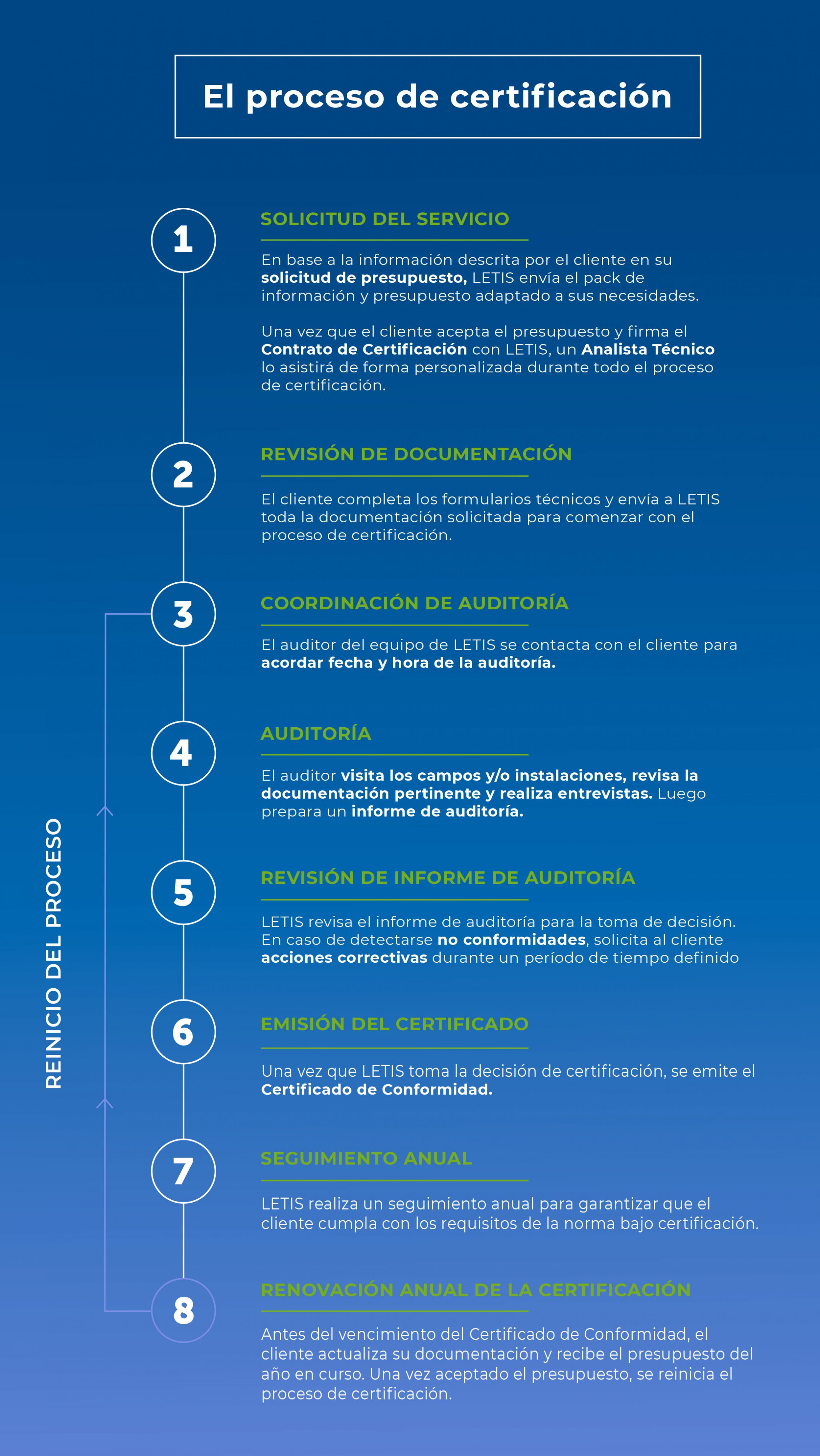
Contáctenos a [email protected] o al teléfono +54 341 528260. Con mucho gusto le brindaremos asistencia. También puede consultar el paso a paso del proceso de certificación aquí.
Todos los productos de LETIS certificados para consumidor final llevan nuestro sello de calidad y una leyenda detallando la norma auditada y certificada.
Sí, puede enviarnos un correo a [email protected], detallando la siguiente información de su interés: producto, norma certificada, país/provincia. También, por favor adjunte información sobre su empresa y el propósito de su contacto.
CAPACITACIONES
LETIS principal sponsor e impulsor del movimiento de jornadas de capacitación STS
Se entiende por “orgánico”, “ecológico” o “biológico” a todo producto vegetal / animal / acuícola proveniente de un sistema de producción sustentable, que mediante el manejo racional de los recursos naturales y sin la utilización de productos de síntesis química, brinde alimentos sanos y abundantes, mientras que permita el mantenimiento o incremento de la fertilidad del recurso, su actividad biótica y la diversidad biológica. Estos productos deben permitir a los consumidores la identificación clara de su condición de orgánico a través de un sistema de certificación que lo garantice.
Los países que poseen legislación orgánica propia sobre la producción y sistema de control orgánico, exigen por ley que los productos rotulados como “orgánico”, “ecológico” o “biológico” sean certificados de acuerdo a su norma nacional, mediante certificadoras de tercera parte acreditadas como LETIS.
Además de ser una fuente de alimentos sanos y medioambientalmente amigables, los productos orgánicos son una tendencia de consumo en crecimiento y atractiva para el productor por sus precios premium. La certificación permite al productor acceder a diferentes mercados internacionales.
Mercados
LETIS ofrece servicios de auditoría y certificación para las normas orgánicas de los siguientes países:
LETIS cuenta con el programa de certificación orgánica de aplicación nacional (Ley 25.127 y sus reglamentaciones), equivalente a la normativa orgánica de la Unión Europea. El programa LETIS SUE permite que los productos orgánicos fabricados en Argentina puedan comercializarse también dentro de los países de la Unión Europea. La certificación se realiza a los largo de la cadena productiva: producción primaria, procesamiento y comercialización.
LETIS certifica una enorme diversidad de producciones agrícola-ganaderas y su agroindustria asociada, avalando la calidad y experiencia en el servicio brindado.
Esta normativa tiene como objetivo asegurar un sistema posible de manejo productivo que:
Respete los sistemas y los ciclos naturales a la vez que preserve y mejore la salud de los ecosistemas.
Contribuya a alcanzar un alto grado de biodiversidad.
Haga un uso responsable de la energía y de los recursos naturales como el agua, el suelo, la materia orgánica y el aire.
La equivalencia SENASA – Unión Europea no incluye los alcances de acuicultura y vitivinicultura. Para estos alcances, ofrecemos los programas LETIS SENASA (Argentina) y LETIS EEQ (Unión Europea).
Aquellos productores ubicados fuera de Argentina y que desean comercializar sus productos en el país, deberán certificar la norma LETIS SENASA.
Desde 2002 los productos orgánicos que deseen ingresar a los Estados Unidos deben cumplir con el Programa Nacional Orgánico NOP (National Organic Program). Este programa está regulado por el USDA (Departamento de Agricultura de los Estados Unidos). LETIS está acreditada directamente por el USDA para auditar y certificar esta normativa en todo el mundo.
A través del programa LETIS NOP-USCOEA, ofrecemos la posibilidad de certificar la equivalencia entre las normas orgánicas de Estados Unidos y Canadá, para así poder acceder a ambos mercados: al mercado estadounidense y canadiense.
Desde 2001 se encuentra vigente el régimen de certificación para productos orgánicos en Japón (Act on Japanese Agricultural Standards – Act No. 175 of 1950).
Operaciones ubicadas en Argentina, todos los alcances (a excepción de bebidas alcohólicas y producción animal): la norma orgánica argentina posee reconocimiento de equivalencia con la norma JAS, a través de un acuerdo bilateral entre SENASA y el Ministerio de Agricultura, Silvicultura y Pesca de Japón (MAFF). LETIS realiza auditorías y certificación de esta norma para los alcances mencionados.
Operaciones ubicadas en Argentina, alcance bebidas alcohólicas: a partir de octubre de 2025, las bebidas alcohólicas que ingresen a Japón deben contar con certificación directa bajo la norma JAS. Para este alcance, LETIS realiza las auditorías en cumplimiento con la norma y trabaja en conjunto con una Certificadora colega, la cual emite la certificación.
LETIS Perú se encuentra autorizada por SENASA Perú y acreditada por INACAL para realizar las auditorías y certificación de la norma orgánica de dicho país, de acuerdo al Reglamento Técnico para los Productos Orgánicos (2006) y al Decreto Supremo DS 010-2010-AG.
LETIS realiza las auditorías para la norma orgánica brasileña, en cumplimiento de la Ley Nº 10.831 y trabaja en conjunto con una Certificadora colega, la cual emite la certificación.
LETIS se encuentra acreditada por la Canadian Food Inspection Agency, para certificar productos orgánicos en cumplimiento con los requerimientos de la norma COR (Canadian Organic Regime). LETIS ofrece esta certificación en todo el mundo.
A través del programa LETIS COR-USCOEA, ofrecemos la posibilidad de certificar la equivalencia entre las normas orgánicas de Canadá y Estados Unidos, para así poder acceder al mercado canadiense y al estadounidense.
LETIS se encuentra acreditada por CAEQ (Comittee on Accreditation for Evaluation of Quality) para certificar la norma CARTv (Quebec). Esta es la norma orgánica de la región de Quebec, Canadá.
Esta norma es obligatoria para:
Cualquier empresa localizada fuera de Quebec que desee comercializar su producción orgánica en la zona de Quebec. A esta certificación se le debe agregar la certificación de la norma COR.
Cualquier empresa dentro de Quebec que desee comercializar su producción dentro de Quebec o cualquier otro lugar de Canadá. A esta certificación se le debe agregar la certificación de la norma COR.
LETIS realiza las auditorías en cumplimiento con la Ley de Productos Orgánicos (LPO) de México DOF 07-02-2006 y trabaja en conjunto con una Certificadora colega, la cual emite la certificación.
LETIS tiene auditores calificados y aprobados para realizar las auditorías para la certificación de productos bajo la Norma Orgánica de Corea del Sur. A través de un acuerdo entre LETIS y la certificadora surcoreana WECERT quien emite los certificados de conformidad de esta norma basados en las auditorías de LETIS.
Servicios de Certificación de Productos Orgánicos de China bajo la Norma Nacional de Productos Orgánicos de China (GB / T 19630-2011).
El estándar GB / T19630-2011 para productos orgánicos es aplicable a todos los productos orgánicos a la venta en el mercado chino, incluidos los productos nacionales e importados. Los productos pueden venderse legalmente como productos orgánicos en el mercado chino solo con la certificación de dicho estándar. El estándar consta de cuatro partes, que especifican respectivamente los requisitos en la producción primaria, procesamiento, calificación, venta y sistema de gestión.
LETIS tiene un acuerdo de cooperación con SRS Shanghai, que es la entidad certificadora acreditada para el Estándar GBT.
LETIS Perú se encuentra autorizada por SENASA Perú y acreditada por INACAL para realizar las auditorías y certificación de la norma orgánica de dicho país, de acuerdo al Reglamento Técnico para los Productos Orgánicos (2006) y al Decreto Supremo DS 010-2010-AG.
LETIS SUE (Argentina-Unión Europea), LETIS SENASA Argentina
LETIS cuenta con el programa de certificación orgánica de aplicación nacional (Ley 25.127 y sus reglamentaciones), equivalente a la normativa orgánica de la Unión Europea. El programa LETIS SUE permite que los productos orgánicos fabricados en Argentina puedan comercializarse también dentro de los países de la Unión Europea. La certificación se realiza a los largo de la cadena productiva: producción primaria, procesamiento y comercialización.
LETIS certifica una enorme diversidad de producciones agrícola-ganaderas y su agroindustria asociada, avalando la calidad y experiencia en el servicio brindado.
Esta normativa tiene como objetivo asegurar un sistema posible de manejo productivo que:
Respete los sistemas y los ciclos naturales a la vez que preserve y mejore la salud de los ecosistemas.
Contribuya a alcanzar un alto grado de biodiversidad.
Haga un uso responsable de la energía y de los recursos naturales como el agua, el suelo, la materia orgánica y el aire.
La equivalencia SENASA – Unión Europea no incluye los alcances de acuicultura y vitivinicultura. Para estos alcances, ofrecemos los programas LETIS SENASA (Argentina) y LETIS EEQ (Unión Europea).
Aquellos productores ubicados fuera de Argentina y que desean comercializar sus productos en el país, deberán certificar la norma LETIS SENASA.
Desde 2002 los productos orgánicos que deseen ingresar a los Estados Unidos deben cumplir con el Programa Nacional Orgánico NOP (National Organic Program). Este programa está regulado por el USDA (Departamento de Agricultura de los Estados Unidos). LETIS está acreditada directamente por el USDA para auditar y certificar esta normativa en todo el mundo.
A través del programa LETIS NOP-USCOEA, ofrecemos la posibilidad de certificar la equivalencia entre las normas orgánicas de Estados Unidos y Canadá, para así poder acceder a ambos mercados: al mercado estadounidense y canadiense.
LETIS se encuentra acreditada por la Canadian Food Inspection Agency, para certificar productos orgánicos en cumplimiento con los requerimientos de la norma COR (Canadian Organic Regime). LETIS ofrece esta certificación en todo el mundo.
A través del programa LETIS COR-USCOEA, ofrecemos la posibilidad de certificar la equivalencia entre las normas orgánicas de Canadá y Estados Unidos, para así poder acceder al mercado canadiense y al estadounidense.
Desde 2001 se encuentra vigente el régimen de certificación para productos orgánicos en Japón (Act on Japanese Agricultural Standards – Act No. 175 of 1950).
Operaciones ubicadas en Argentina, todos los alcances (a excepción de bebidas alcohólicas y producción animal): la norma orgánica argentina posee reconocimiento de equivalencia con la norma JAS, a través de un acuerdo bilateral entre SENASA y el Ministerio de Agricultura, Silvicultura y Pesca de Japón (MAFF). LETIS realiza auditorías y certificación de esta norma para los alcances mencionados.
Operaciones ubicadas en Argentina, alcance bebidas alcohólicas: a partir de octubre de 2025, las bebidas alcohólicas que ingresen a Japón deben contar con certificación directa bajo la norma JAS. Para este alcance, LETIS realiza las auditorías en cumplimiento con la norma y trabaja en conjunto con una Certificadora colega, la cual emite la certificación.
LETIS tiene auditores calificados y aprobados para realizar las auditorías para la certificación de productos bajo la Norma Orgánica de Corea del Sur. A través de un acuerdo entre LETIS y la certificadora surcoreana WECERT quien emite los certificados de conformidad de esta norma basados en las auditorías de LETIS.
Servicios de Certificación de Productos Orgánicos de China bajo la Norma Nacional de Productos Orgánicos de China (GB / T 19630-2011).
El estándar GB / T19630-2011 para productos orgánicos es aplicable a todos los productos orgánicos a la venta en el mercado chino, incluidos los productos nacionales e importados. Los productos pueden venderse legalmente como productos orgánicos en el mercado chino solo con la certificación de dicho estándar. El estándar consta de cuatro partes, que especifican respectivamente los requisitos en la producción primaria, procesamiento, calificación, venta y sistema de gestión.
LETIS tiene un acuerdo de cooperación con SRS Shanghai, que es la entidad certificadora acreditada para el Estándar GBT.
LETIS Perú se encuentra autorizada por SENASA Perú y acreditada por INACAL para realizar las auditorías y certificación de la norma orgánica de dicho país, de acuerdo al Reglamento Técnico para los Productos Orgánicos (2006) y al Decreto Supremo DS 010-2010-AG.
LETIS Bioteam, autorizado por el Ministerio de Agricultura y Forestación de Turquía como Órgano de Control y Certificación de Agricultura, ofrece los servicios de auditoría y certificación de la norma orgánica de Turquía.
Además, está acreditado por la Agencia de Acreditación de Turquía y se rige acorde con la Ley de Agricultura Orgánica No. 5262 y la Regulación de Prácticas y Principios de Agricultura Orgánica de Turquía.
LETIS realiza las auditorías para la norma orgánica brasileña, en cumplimiento de la Ley Nº 10.831 y trabaja en conjunto con una Certificadora colega, la cual emite la certificación.
LETIS realiza las auditorías en cumplimiento con la Ley de Productos Orgánicos (LPO) de México DOF 07-02-2006 y trabaja en conjunto con una Certificadora colega, la cual emite la certificación.
El Certificado GLOBALG.A.P. abarca las Buenas Prácticas Agrícolas a nivel global. Contempla principalmente los siguientes puntos: trazabilidad (seguimiento), técnicas de producción (uso controlado de agroquímicos), protección del medio ambiente, aspectos higiénicos (no contaminación química, física y biológica) y sociales (ambiente de trabajo adecuado). Está conformada por módulos integrando el proceso de producción, desde su comienzo hasta que el producto es retirado del establecimiento.
GLOBALG.A.P. es una certificación “business to business (B2B)”, lo que significa que conecta, a través de un certificado de conformidad, a su empresa con otras tales como comercializadoras, distribuidoras y supermercados internacionales y nacionales, que buscan proveedores de alta calidad comprobada.
LETIS está acreditada para certificar el alcance GLOBALG.A.P. IFA (Norma para el Aseguramiento Integrado de Fincas) en frutas, hortalizas y cultivos a granel.
¿Cómo certificar?
La Norma GLOBALG.A.P. se estructura en un sistema de módulos que permite a los productores certificarse para varios sub-ámbitos en una sola auditoría. Está compuesta por:
Reglamento General: Contiene los criterios para lograr una exitosa implementación de los PCCCs y establece las guías para la verificación y regulación de la norma.
Puntos de Control y Criterios de Cumplimiento (PCCC): Claramente definen los requisitos para lograr el estándar de calidad requerido por GLOBALG.A.P.
Los Puntos de Control y Criterios de Cumplimiento (PCCC) también se estructuran en módulos, y están conformados por:
El Módulo Base para Todo Tipo de Explotación Agropecuaria: Es la base de todas las normas y contiene todos los requisitos que los productores deben cumplir primero para obtener la certificación.
El Módulo del Ámbito: Establece criterios claros para los diferentes sectores de la producción alimentaria. GLOBALG.A.P. cubre 3 ámbitos: Cultivos, Animales y Acuicultura
El Módulo del Sub-Ámbito: Estos PCCC cubren los requisitos para un producto específico o un aspecto diferente de la producción de alimentos y la cadena de suministro.
Para obtener la certificación, los productores deben cumplir con todos los PCCC relevantes de su sub-ámbito. Por ejemplo, un productor de fresas debe cumplir con los PCCC del Módulo Base para Todo Tipo de Explotación Agropecuaria, los PCCC del Módulo Base para Cultivos, y los PCCC de Frutas y Hortalizas para recibir el Certificado de la Norma GLOBALG.A.P. IFA para Frutas y Hortalizas.
Opciones de certificación:
Opción 1: Productor individual con o sin un Sistema de Gestión de Calidad opcional. El certificado se emite a su nombre.
Opción 2: Múltiples productores con un Sistema de Gestión de Calidad obligatorio. El Certificado se emite a nombre de la asociación, con un anexo que incluye el detalle de todos los productores bajo el alcance del certificado.
Como respuesta a las crecientes inquietudes que han surgido en torno a determinados temas del proceso de producción agropecuaria y de la cadena de suministro, GLOBALG.A.P. desarrolló los módulos «add-on». Estos módulos, voluntarios y adicionales, buscan optimizar su certificación GLOBALG.A.P.
FSMA PSR –Ley de Modernización de Inocuidad de los Alimentos (Food Safety Modernization Act – FSMA), de la Administración de Alimentos de los Estados Unidos (FDA).
La FDA promulgó esta ley en 2011 que abarca los productos para exportación a EEUU y también su producción interna, y exige que se implementen y sigan prácticas específicas para la producción, manipulación e importación de productos alimenticios.
Con el fin de apoyar a los productores en la implementación de estas prácticas, GLOBALG.A.P. ofrece su add-on FSMA PSR para tratar los puntos de control que se encuentran en la Regla sobre Seguridad de Productos de la FSMA (FSMA PSR).
Este Add-On ayuda a los productores a identificar los requisitos de la FSMA que deben abordarse a nivel de la granja, cuando va acompañado por la certificación IFA FV.
Se pueden mostrar los informes de inspección y los certificados de IFA FV y del add-on FSMA PSR a los importadores, los minoristas y los participantes de la cadena de valor como prueba del trabajo realizado por el productor para la implementación de la FSMA.
GRASP – Evaluación de Riesgos GLOBALG.A.P. para las Prácticas Sociales GLOBALG.A.P. Risk Assessment on Social Practice)
Es un módulo voluntario desarrollado para evaluar las prácticas sociales en la explotación, abordando temas específicos relativos a la salud, seguridad y bienestar de los trabajadores.
Como complemento de la Certificación GLOBALG.A.P., ayuda a los productores a establecer un buen sistema de gestión social en sus explotaciones, ofreciendo a los compradores una garantía adicional y protegiendo uno de los recursos más importantes de la explotación: sus trabajadores.
Las medidas GRASP pueden evaluarse al mismo tiempo que se realiza la auditoría GLOBALG.A.P. Un auditor o inspector GLOBALG.A.P. con formación en GRASP realiza la evaluación GRASP en su explotación. Los resultados de la evaluación se cargan en la Base de Datos GLOBALG.A.P., mostrando su nivel de cumplimiento. Esto es visible para los socios en la cadena de suministro y los compradores a los que se les haya otorgado acceso.
SPRING – Programa sostenible de riego y uso de aguas subterráneas
SPRING es un add-on a nivel de la granja que ayuda a los productores, a los minoristas y a los comerciantes a demostrar su compromiso con la gestión sostenible del agua, y puede aplicarse junto con la norma GLOBALG.A.P. IFA para Cultivos. SPRING incorpora un gran número de criterios para evaluar si en la granja se realiza una gestión sostenible del agua. Algunos de estos criterios son los siguientes:
Conformidad legal de las fuentes de agua y tasas de extracción
Seguimiento del consumo de agua
Impacto de los productores en la gestión sostenible de cuencas hidrográficas
Mejores prácticas en la gestión del agua
Protección de fuentes de agua
Medidas que demuestren que se mejora continuamente la gestión del agua
Aquellos productores que aplican de manera eficaz el add-on SPRING reciben un certificado de conformidad, que también se puede ver en la base de datos GLOBALG.A.P. Los actores autorizados de las cadenas de suministro también pueden acceder al informe de auditoría completo como un «observador SPRING», a través de la base de datos GLOBALG.A.P.
Lorem ipsum dolor sit amet, consectetur adipiscing elit. Ut elit tellus, luctus nec ullamcorper mattis, pulvinar dapibus leo.
LETIS BPA (Buenas Prácticas Agrícolas)
El Programa LETIS BPA garantiza la verificación confiable del cumplimiento de las Buenas Prácticas Agrícolas, cuya implementación es obligatoria en Argentina desde 2020 para fruticultura y desde 2021 para hortalizas, de acuerdo a la resolución del Gobierno Nacional Argentino 5/2018.
El programa LETIS BPA permite gestionar efectivamente todo el proceso con la norma IRAM 14110, incorporando una visión sustentable a la producción primaria de alimentos y realizando un uso eficiente de los recursos y un apropiado manejo integrado de plagas y enfermedades.
Esta norma tiene como finalidad establecer los criterios generales que permitan obtener productos inocuos para el consumo. Su campo de aplicación incluye la producción, cosecha, almacenamiento, acondicionamiento y transporte.
LETIS audita y certifica diferentes protocolos privados. Su empresa puede solicitar a LETIS la elaboración de un protocolo de acuerdo a sus necesidades, o bien optar por la certificación de un protocolo privado vigente.
a) Miel libre de Organismos Genéticamente modificados (OGM)
Este protocolo ha sido desarrollado por LETIS como respuesta a la necesidad de que la miel y otros productos de la colmena tengan una locación cierta, un asentamiento verificado y auditado, y que toda la cadena productiva posea un sistema de trazabilidad que permita evitar la mezcla con productos diferentes a los certificados, o una contaminación de OGM.
Con el convencimiento de que los consumidores exigen cada vez más una clara identificación de los productos que eligen para llevar a su mesa, entendemos que realizar un etiquetado específico, requiere de la responsabilidad del cumplimiento y verificación acerca del mismo, por ello se incluye la certificación de tercera parte.
SECTORES VINCULADOS
APICULTURA
DOCUMENTOS RELEVANTES
Miel libre de Organismos Genéticamente Modificados (OGM)
b) Protocolo para la producción de fardos de alfalfa
Es un Protocolos privado de LETIS para cumplir con Buenas Prácticas Agrícolas en la elaboración de fardos de alfalfa.
La producción de fardos deberá asegurar, a través de técnicas de BPA, que los mismos estén libres de malezas tóxicas y fitosanitarios prohibidos para este cultivo.
Otros puntos a controlar están referidos a la higiene del cultivo, salud y seguridad de los trabajadores, manejo, almacenamiento, transporte y trazabilidad de la producción.
El Sello “Alimentos Argentinos, una elección natural” es una marca país que busca diferenciar a los alimentos producidos en Argentina bajo un estándar de calidad premium. Lo otorga la Secretaría de Agricultura, Ganadería y Pesca a los productos que lo soliciten y cumplan con los requisitos establecidos en protocolos específicos.
LETIS realiza las auditorías de tercera parte de este programa.
Los productos que cuenten con este Sello pueden obtener un 0,5% adicional a la posición arancelaria en los Reintegros a la Exportación (Decreto PEN N°1341/16).
Protocolo de Autoevaluación de Sustentabilidad Vitivinícola
Este Protocolo para el Desarrollo Sostenible de la Vitivinicultura Argentina de Bodegas de Argentina, junto con su Reglamento, integra el Programa de Sustentabilidad para la Industria Vitivinícola Argentina. Se trata de una iniciativa colaborativa desarrollada por la Comisión de Sustentabilidad de Bodegas de Argentina, que provee a sus asociados y a la vitivinicultura de Argentina en general con herramientas educativas y de sensibilización para incrementar la aplicación de prácticas sustentables en sus viñedos y/o bodegas y medir y demostrar su progreso. El Programa de Sustentabilidad para la industria vitivinícola argentina tiene como objetivo fortalecer la sustentabilidad ambiental, social y económica y la competitividad de la industria vitivinícola argentina en el largo plazo.
¿En qué consiste la certificación? La certificación implica un proceso de mejora continua, a lo largo de sucesivas auditorías. En cada certificación, el establecimiento vitivinícola deberá proponer un programa de mejora continua, que será auditado en la auditoría siguiente. El protocolo contempla criterios aplicables tanto a viñedos como a bodegas, y cada operador puede optar por certificar una de estas etapas o ambas de manera integrada. Para aprobar la evaluación se requiere el cumplimiento del 100 % de los criterios obligatorios y al menos un 65 % del total de criterios aplicables establecidos en el protocolo, con un tiempo mínimo de tres meses de implementación antes de la certificación.
La metodología de evaluación combina criterios obligatorios y no obligatorios, sobre los cuales el establecimiento debe realizar una autoevaluación previa y elaborar un plan de mejora continua. El grado de cumplimiento se mide en función de los criterios aplicables y se verifican los avances en auditorías posteriores.
LETIS realiza las auditorías y emite el Certificado. Bodegas de Argentina avala el certificado emitido por LETIS mediante la emisión de un certificado de aval. Bodegas de Argentina es quien habilita el uso del logo del Protocolo de Sustentabilidad y el cartel a instalar en los establecimientos, acreditando la certificación obtenida.
La certificación del sistema de gestión de la sustentabilidad tiene una validez de tres años. Cumplido este plazo, la certificación deberá renovarse mediante una nueva auditoría integral, realizada dentro de los cuatro meses posteriores al vencimiento de la anterior. Para ello, el establecimiento deberá presentar una nueva autoevaluación y un plan actualizado de mejoras. Entre los beneficios de la certificación, además del uso del logo oficial y el cartel de Bodegas de Argentina, se incluyen la posibilidad de participar en espacios de difusión sectoriales y demostrar ante clientes y mercados internacionales el compromiso con la sustentabilidad ambiental, social y económica.
GAESVA (Guía de Autoevaluación de la Sostenibilidad Vitivinícola Argentina)
El proyecto de Sostenibilidad Vitivinícola Argentina surge en el marco de uno de los objetivos y ejes del Plan Estratégico Vitivinícola de la Argentina al 2030 e impulsado por la Corporación Vitivinícola Argentina en el año 2021. En esta línea se desarrolla la Guía de Autoevaluación de la Sostenibilidad (GAESVA).
La GAESVA es una herramienta poderosa para la autoevaluación de prácticas de responsabilidad social y sostenibilidad en empresas vitivinícolas de diversas dimensiones y estados de evolución en dicha temática.
La Guía, integrando recomendaciones internacionales como la aplicación de los cinco “Principios Generales de Sostenibilidad” de la Organización de la Vid y el Vino, intenta ser flexible y aplicable a las condiciones técnicas, éticas, culturales, ambientales y sociales de la vitivinicultura argentina.
¿Quiénes pueden obtener la certificación?
La GAESVA se adapta a diferentes actividades y producciones vitivinícolas, segmentadas por escala, incluyendo:
Productores primarios de uva.
Bodegas elaboradoras y/o fraccionadoras de vino y/o elaboradoras de mosto sulfitado.
Fábricas elaboradoras de jugo de uva concentrado.
Productores y elaboradores de pasas (secadas al sol o deshidratadas en hornos).
¿En qué consiste la certificación?
LETIS realizará auditorías “in situ” para verificar el cumplimiento de los indicadores aplicables al menos en el Nivel 1 y elaborar un informe detallando el nivel alcanzado en cada indicador. Para determinar el cumplimiento con respecto a un nivel determinado y poder acceder a la certificación, todos los sitios deberán demostrar cumplimiento, como mínimo, en el Nivel 1.
Luego de la/s auditoría/s “in situ”, LETIS tomará la decisión final de certificación en función del informe de auditoría.
El certificado tendrá una validez de dos años a partir de la fecha de decisión de certificación.
Cada organización o grupo de productores podrá utilizar el Sello Argentina Sostenible (SAS) durante el tiempo de dos años que dure la certificación.
El Sello podrá ser utilizado en conjunto con su marca comercial en el mismo producto, en su embalaje, en sus diversas publicidades, como un elemento distintivo de la marca comercial.
Certificación HACCP - Sistema de Análisis de Peligros y Puntos Críticos de Control (Hazard Analysis and Critical Control Points).
El sistema HACCP es empleado a nivel mundial y reconocido y exigido internacionalmente.
Ayuda a las organizaciones a centrarse en los peligros biológicos, químicos y físicos que afectan la seguridad e higiene de los alimentos, mediante el establecimiento de los Puntos Críticos de Control (PCCs) en el proceso de producción. Es un sistema básicamente preventivo, teniendo como objetivo disminuir los peligros de contaminación y entregar productos seguros a los clientes y consumidores.
Se debe considerar la implementación de BPM como pre-requisito para la certificación HACCP.
El programa LETIS HACCP otorga esta certificación de acuerdo a la norma IRAM 323 para países del Mercosur, o de acuerdo al Codex Alimentarius para otros países.
Algunas de las ventajas de contar con esta certificación:
Permite la producción inocua de alimentos.
Al contar con reconocimiento internacional, mejora su imagen institucional e incrementa el prestigio de su marca.
Abre nuevas oportunidades de negocios en distintos mercados internacionales.
Al eliminar o minimizar los riesgos para el consumidor, disminuyen los costos de reclamos y devoluciones.
El sello de Calidad Certificada Tierra del Fuego-Fin del Mundo es una marca territorial desarrollada por la Provincia de Tierra del Fuego, Argentina. Busca diferenciar a productos producidos en esta Provincia, cuya calidad, sustentabilidad y responsabilidad social cumplan con los requisitos establecidos.
Este sello abarca protocolos de calidad, responsabilidad ambiental y social para diversas producciones de la Provincia, tales como la producción ovina para carne, acuicultura, productos gourmet y mueblería.
LETIS Inspecciona, verifica el cumplimiento y otorga el sello de calidad certificada Tierra del Fuego-Fin del Mundo.
SECTORES VINCULADOS
AGRICULTURA
ACUICULTURA
GANADERÍA
RECOLECCIÓN SILVESTRE
DOCUMENTOS RELEVANTES
Miel libre de Organismos Genéticamente Modificados (OGM)
LETIS brinda servicios a la actividad agrícola desde 1998, certificando producciones orgánicas, protocolos de calidad y buenas prácticas agrícolas en granos, fibras, frutas y hortalizas, semillas y material de propagación.
La certificación es una herramienta comercial para acceder a nuevos mercados, establecerse en mercados existentes, incrementar la venta de determinados productos y agregar valor a los mismos.
El cumplimiento de protocolos de calidad como BPA, GLOBALG.A.P. y Orgánicos se ha vuelto requisito para poder ingresar a los principales mercados del mundo. La certificación orgánica asegura la trazabilidad y diferenciación de sus productos.
El sello LETIS Gallinas Libres busca cumplir con exigencias de los consumidores, brindando herramientas para facilitar la transparencia y la comunicación de la esencia, el propósito y las formas de trabajar detrás de cada producto.
Este sello «Business to Consumer» (dirigidos al consumidor) es de fácil visualización en los productos certificados y está respaldado por un protocolo de calidad y sistema de auditoría y certificación precisos y responsables.
La certificación LETIS Gallinas Libres facilita la elección de huevos provenientes de gallinas criadas con prácticas que atienden al bienestar animal, tales como el manejo del alojamiento, la alimentación, la sanidad y el tratamiento veterinario, buscando reproducir las condiciones naturales de las mismas y por lo tanto reduciendo su estrés y garantizando una mejor calidad de vida para los animales.
Algunos de los requisitos de este sello están cubiertos por la certificación orgánica, por lo que hemos desarrollado un modelo de certificación combinado, en el cual nuestros clientes pueden optar por ambas certificaciones bajo un mismo sistema de auditoría.
Las Buenas Prácticas de Manufactura son una herramienta básica para la obtención de productos seguros para el consumo humano, que se centralizan en la higiene y forma de manipulación.
El programa LETIS BPM otorga esta certificación de acuerdo a la norma IRAM 324.
Esta norma es aplicable a establecimientos en los cuales se realicen algunas de las actividades siguientes: elaboración, industrialización, fraccionamiento, almacenamiento, transporte y distribución de alimentos e insumos en contacto con ellos.
El cumplimiento de las BPM es de carácter obligatorio para todos los establecimientos elaboradores de alimentos que produzcan en Argentina, y es un pre-requisito para la Certificación HACCP, Programa TQM o cualquier otro sistema de Gestión de Calidad como ISO 9000 en empresas agroalimentarias.
Respondiendo a las exigencias de los consumidores y en constante búsqueda de brindar herramientas que faciliten la transparencia y la comunicación de la esencia, el propósito y las formas de trabajar detrás de cada producto, nuestro equipo ha desarrollado el sello de calidad LETIS Vegan.
Este sello «Business to Consumer» (dirigidos al consumidor) es de fácil visualización en los productos certificados y está respaldado por un protocolo de calidad y un sistema de auditoría y certificación precisos y responsables.
La certificación LETIS Vegan brinda transparencia a consumidores que eligen productos que no contengan ingredientes o subingredientes de origen animal, que no hayan sido experimentados en animales, y que hayan sido producidos y trazados con prácticas de manufacturas que eviten la contaminación cruzada con productos que no cumplan dichas características.
Algunos de los requisitos de este sello están cubiertos por la certificación orgánica, HACCP y BPM, por lo que hemos desarrollado un modelo de certificación combinado, en el cuál nuestros clientes pueden optar por estas certificaciones bajo un mismo sistema de auditoría.
La norma mundial BRCGS para la seguridad alimentaria es una de las herramientas más empleadas a nivel global para llevar a cabo la diligencia debida y la aprobación de proveedores. Originalmente desarrollada en 1998 por el consorcio British Retail, esta norma se actualiza regularmente con la colaboración de las partes interesadas internacionales de la cadena de suministro. Actualmente, es una herramienta global que se basa en las normas y metodologías más recientes y avanzadas en seguridad alimentaria, y cuenta con el reconocimiento de la Iniciativa Mundial de Seguridad Alimentaria (GFSI).
La norma ayuda a las empresas a seleccionar y evaluar a sus proveedores, ofreciendo un sistema de trabajo para gestionar la seguridad, integridad, legalidad y calidad de los productos en la industria de la fabricación, así como en el procesamiento y envasado de alimentos e ingredientes alimentarios.
A través de la auditoría y certificación BRCGS, las empresas podrán demostrar su compromiso con la seguridad alimentaria, asegurando que sus productos cumplan con las normativas más rigurosas y las expectativas de los consumidores más exigentes.
¿Qué beneficios ofrece la certificación BRCGS a los sitios que la obtienen?
La Norma BRCGS influye en ventas de productos por un valor de US$ 800,000 millones, desempeñando un papel crucial en garantizar el suministro de alimentos seguros. Por ello, organizaciones internacionales promueven su adopción para fortalecer los sistemas de seguridad alimentaria y cumplir con regulaciones.
La implementación y certificación de esta Norma ofrece varios beneficios a las empresas alimenticias y sus clientes, incluyendo:
Cobertura integral que abarca la seguridad, autenticidad, legalidad y calidad de los productos.
Una norma y protocolo únicos para auditorías acreditadas por organismos de certificación externos, permitiendo una evaluación independiente y confiable de los sistemas de gestión de calidad y seguridad alimentaria.
Cumplimiento de parte de los requisitos de «debida diligencia» tanto para el fabricante certificado como para sus clientes.
Garantía de que los proveedores implementan buenas prácticas de gestión en seguridad alimentaria.
Implementación de acciones correctivas, análisis de causa raíz y medidas preventivas para todas las no conformidades, lo que disminuye la necesidad de seguimiento por parte de los clientes y demuestra mejora continua.
Reconocimiento internacional de la Norma, comparable con GFSI, proporcionando un informe y certificación que pueden ser aceptados por los clientes en lugar de realizar sus propias auditorías, reduciendo costos y tiempo.
Oportunidad para las empresas certificadas de aparecer en la sección pública del BRCGS Directory, permitiendo el reconocimiento de sus logros y el uso comercial de un logotipo.
Acceso gratuito a un conjunto completo de herramientas para fomentar la mejora continua.
Amplia gama de opciones de auditoría, incluyendo programas de auditorías anunciadas, no anunciadas y combinadas, adaptadas a las necesidades de los clientes y permitiendo que las empresas demuestren cumplimiento de acuerdo con sus operaciones y la madurez de sus sistemas de seguridad alimentaria.
LETIS se encuentra acreditado solamente para el procesamiento de alimentos en todas las categorías de productos acorde a BRCGS para Food Safety, Issue 9.
Esta norma establece los requisitos para la fabricación, el procesamiento y el envasado de:
Alimentos procesados, tanto de marca propia como de marca externa
Materias primas o ingredientes para uso por parte de empresas de servicios de alimentos, empresas de servicio de alimentos y fabricantes de alimentos
Productos primarios, como fruta y verdura
Alimentos para mascotas domésticas y piensos
Productos de conversión primaria animal.
La certificación será válida para aquellos productos que hayan sido fabricados o preparados en los establecimientos auditados e incluye las instalaciones de almacenamiento que estén bajo el control directo de la gerencia del establecimiento de producción.
Esta Norma no se aplica a actividades relacionadas con el mayoreo, la importación, distribución o el almacenamiento de productos alimentarios que están fuera del control directo de la empresa.
LETIS brinda servicios al sector ganadero desde 1998, certificando producciones bovinas, caprinas, ovinas, porcinas y otros animales de granja, frigoríficos y otras plantas de procesamiento.
La certificación puede ser utilizada como una herramienta comercial para acceder a nuevos mercados, establecerse en mercados exigentes, incrementar la venta de determinados productos o lograr valor agregado en los productos.
Cuando la ganadería se desarrolla con una relación armónica entre la tierra, las plantas, y el ganado, y respeta las necesidades fisiológicas y de comportamiento de los animales, mediante una combinación de medidas destinadas a proporcionar alimentos de buena calidad producidos orgánicamente, manteniendo densidades de ganado apropiadas a las necesidades de comportamiento y adoptando prácticas de manejo pecuario que minimicen el estrés y busquen favorecer el bienestar animal, adquiere esta producción un valor diferencial que puede ser resaltado mediante un sistema de certificación.
La miel es un producto cada vez más demandado a nivel mundial. La certificación puede ser utilizada como una herramienta comercial para acceder a nuevos mercados, establecerse en mercados existentes, incrementar la venta de determinados productos o lograr valor agregado en los mismos.
Cuando la miel se extrae a partir de un sistema de producción sustentable en el tiempo, mediante el manejo racional de los recursos naturales y sin la utilización de productos de síntesis química, estas características pueden ser claramente identificadas por los consumidores por medio de un sistema de certificación de producción orgánica.
LETIS es empresa líder en certificación de producciones apícolas, con un equipo que cuenta con más de 15 años de experiencia en la actividad.
La Acuicultura es la actividad en alimentos de mayor crecimiento en el mundo, y las certificaciones de calidad son claves para ingresar a los mercados más exigentes.
LETIS certificó la primera producción acuícola orgánica de Argentina, un emprendimiento de trucha arcoiris en la Patagonia, y hoy certifica producciones de peces y moluscos bivalvos en diversos países de Latinoamérica.
LETIS es líder en la certificación de viñedos y bodegas, contando desde 1998 con un equipo altamente experimentado en la industria vitivinícola.
La certificación puede ser utilizada como una herramienta comercial para acceder a nuevos mercados, establecerse en mercados existentes, incrementar la venta de determinados productos o lograr valor agregado en los productos.
El agregado de valor en la producción de alimentos y bebidas es certificado por LETIS en sus diferentes etapas, desde el acopio y acondicionamiento de cereales, a la elaboración de jugos de frutas, panificados, elaboración de productos gourmet, entre otros.
LETIS brinda servicios al sector de recolección silvestre desde 1998, certificando recolección de plantas, algas, frutos, hongos, entre otros, y sus procesamientos. Las técnicas de recolección silvestre evitan conscientemente la explotación de las comunidades de plantas silvestres y se llevan a cabo con sumo cuidado y respeto por la naturaleza.
La certificación puede ser utilizada como una herramienta comercial para acceder a nuevos mercados, establecerse en mercados existentes, incrementar la venta de determinados productos o lograr valor agregado en los productos.
LETIS brinda el servicio de evaluación y aprobación de insumos comerciales para ser utilizados en la producción orgánica. Los insumos que obtengan la aprobación podrán utilizar un sello distintivo, lo cual les otorga un mayor valor agregado, permitiéndoles así diferenciarse en el mercado. Además LETIS publica en su página web la “Lista de Insumos Aprobados para Uso en Agricultura Orgánica” donde las empresas demandantes de insumos orgánicos, personas e instituciones afines podrán conocer las marcas comerciales, fabricantes y registrantes de los insumos autorizados.
Para que un producto se venda como orgánico, para la mayoría de las normas orgánicas, el comercializador debe estar certificado como tal.
Todos los productos orgánicos importados a la UE deben tener el correspondiente certificado electrónico de inspección (e-COI). Estos son emitidos y administrados por LETIS a través del Sistema Experto (TRACES). Tenga en cuenta que si no tiene un certificado electrónico de inspección, sus productos no serán entregados en su puerto de llegada a la UE.
La comercialización de productos orgánicos certificados por LETIS para las normas SENASA Argentina y SENASA Perú para fines nacionales o internacionales, también requiere la emisión de Certificados Transaccionales para cada transacción. El mismo debe ser solicitado a LETIS por un operador certificado.
En el caso de NOP (EE.UU.), según las regulaciones orgánicas actuales del USDA, los comercializadores que no manipulan físicamente productos orgánicos no están obligados a estar certificados. Sin embargo, pueden certificarse voluntariamente. De hecho, muchos comerciantes optaron por obtener la certificación, por ejemplo, para figurar en la base de datos oficial de integridad del USDA. Tenga en cuenta que los cambios propuestos a los reglamentos orgánicos del USDA eliminan las exclusiones de la certificación y requerirían que todos los comercializadores estén certificados. Las nuevas reglas entrarán en vigencia en 2022.
Para más información sobre los requisitos para comercializadores para otros mercados, ¡contáctenos! [email protected]
Cosméticos Orgánicos: La certificación orgánica tiene como objetivo verificar que en el procesamiento de cosméticos y las materias primas que se están utilizando han sido producidas siguiendo los criterios para la agricultura orgánica. Estos criterios incluyen la no utilización de fertilizantes, pesticidas ni herbicidas químicos de síntesis química manteniendo una producción sustentable y saludable con el medio ambiente. De esta manera, disminuye en los cosméticos el contenido de sustancias químicas agresivas para la piel y de contaminantes que afecten al medio ambiente.
Los cosméticos, los productos para el cuidado personal y para el cuidado corporal certificados por NOP (USDA) son elegibles para las mismas 4 categorías de etiquetado orgánico que todos los demás productos agrícolas, según su contenido orgánico y otros factores:
“100% orgánico”: el producto debe contener (excluyendo agua y sal) solo ingredientes producidos orgánicamente. Los productos pueden mostrar el sello orgánico del USDA y deben mostrar el nombre y la dirección de LETIS, como agente certificador.
“Orgánico”: el producto debe contener al menos un 95 por ciento de ingredientes producidos orgánicamente (excluyendo agua y sal).
“Hecho con ingredientes orgánicos”: los productos contienen al menos un 70 por ciento de ingredientes orgánicos y la etiqueta del producto puede enumerar hasta tres de los ingredientes orgánicos o grupos de “alimentos” en el panel de visualización principal. Por ejemplo, la loción corporal hecha con al menos un 70 por ciento de ingredientes orgánicos (excluyendo agua y sal) y solo hierbas orgánicas puede etiquetarse como «loción corporal hecha con lavanda, romero y manzanilla orgánicos» o «loción corporal hecha con hierbas orgánicas». » Los productos no pueden mostrar el sello orgánico del USDA y deben mostrar el nombre y la dirección de LETIS, como agente certificador.
Menos del 70 por ciento de ingredientes orgánicos: Los productos no pueden usar el término “orgánico” en ninguna parte del panel de exhibición principal. Sin embargo, pueden identificar los ingredientes específicos que están certificados por el USDA como producidos orgánicamente en la declaración de ingredientes en el panel de información.
BPM en producción de Cosméticos: Las Buenas Prácticas de Manufactura son una herramienta básica para la obtención de productos seguros para el consumo humano, que se centralizan en la higiene y forma de manipulación.
El programa LETIS BPM otorga esta certificación de acuerdo a la norma IRAM 324.
Esta norma es aplicable a establecimientos/fábricas/laboratorios en los cuales se realicen algunas de las actividades siguientes: elaboración, industrialización, fraccionamiento, almacenamiento, transporte y distribución.